

Quick Answer: Best Heating System for Northern Virginia Homes in 2026
For many Northern Virginia homes, the best type of heating system in 2026 is a heat pump, gas furnace, dual-fuel system, boiler, or ductless mini-split. The right choice depends on ductwork, fuel source, insulation, home age, comfort problems, and long-term energy bills. A furnace is still the most common heating system in many Northern Virginia homes with natural gas and existing ductwork. But heat pumps are popular because they can heat and cool your home with one HVAC system. This guide is for homeowners in Fairfax County, Arlington, Alexandria, Loudoun County, Vienna, , Ashburn, and nearby areas who want a practical heating choice, not a generic answer.
Why Northern Virginia Homes Need a Local Heating Strategy
Northern Virginia has mixed weather. Winters bring cold nights, damp air, and sudden temperature drops. Summers bring humidity and heavy air conditioning use. That means your heating, ventilation, and air conditioning system should support year-round comfort, not just winter heating. A newer home in Ashburn or Fairfax may already have strong ductwork. An older home in Arlington, Alexandria, Vienna, or Falls Church may have aging ducts, radiators, older insulation, or limited space for new equipment. A local heating strategy should consider:
- Northern Virginia weather
- Home age and layout
- Existing ductwork
- Indoor air quality
- Fuel source
- Energy efficiency
- Long-term repair risk
- Comfort throughout your home
This is why the best system for Northern Virginia homes depends on the house.
What to Consider Before Choosing a Heating System
Existing Ductwork and Airflow
Ductwork affects airflow, heating, cooling, pressure, and HVAC efficiency. If your ducts leak, are undersized, or do not reach certain rooms, a new HVAC system may still leave cold spots. Duct sealing can help reduce wasted energy and improve comfort. Check for:
- Weak airflow
- Cold rooms
- Dusty indoor air
- Uneven heating
- High energy bills
- Noisy duct movement
If ductwork is in good shape, a gas furnace, heat pump, or dual-fuel system may work well. If your home has no ducts, a ductless mini-split may be better.
Fuel Source: Gas, Electric, Propane, or Oil
Fuel changes your best option. Natural gas often works well with a gas furnace. Electricity works well with air-source heat pumps, cold-climate heat pumps, and ductless systems. Propane or oil may still be used in some rural Virginia homes. Electric heat can be simple, but electric resistance heating may cost more to run than a heat pump.
Home Age, Insulation, and Layout
Older homes may need a different plan than newer homes. Northern Virginia older homes may have radiators, older ducts, or weaker thermal insulation. Also consider:
- Square footage
- Ceiling height
- Window placement
- Basement comfort
- Rooms over garages
- Sunrooms
- Additions
- Thermostat location
Well-insulated homes usually keep heat better and may use less energy.
Top Heating System Options for Northern Virginia Homes
Gas Furnace: Best for Strong Heat and Existing Ductwork
A gas furnace heats air and moves it through ducts. It is a strong option for homes with natural gas and existing ductwork. Best for:
- Ducted homes
- Natural gas homes
- Larger homes
- Strong winter heat
- Furnace replacement
When comparing furnaces, check the AFUE rating. A higher AFUE rating means more fuel becomes usable heat.
Heat Pump: Best for Energy-Efficient Heating and Cooling
A heat pump can heat and cool your home with one system. Heat pumps work by transferring heat instead of creating heat. An air-source heat pump extracts heat from outside in winter and moves heat from inside during summer cooling. Best for:
- Heating and cooling in one system
- Lower energy bills
- Energy-efficient heating
- Well-insulated homes
- Replacing AC and heating together
Compare SEER2 rating for cooling and HSPF2 rating for heating. An ENERGY STAR certified heat pump may also qualify for certain rebates or tax credits.
Cold-Climate Heat Pump: Best for Better Winter Performance
A cold-climate heat pump is designed to perform better in colder weather than older heat pump models. Best for:
- Electric homes
- Efficiency-focused homeowners
- Well-insulated homes
- Lower winter energy use
Some systems still use backup heat or auxiliary heat during very cold nights. That is normal, but if auxiliary heat runs too often, the system may need service, better sizing, or thermostat adjustment.
Dual-Fuel Heating System: Best for Efficiency With Backup Heat
A dual-fuel system pairs a heat pump with a gas furnace. The heat pump handles mild days. The furnace helps during colder weather. Best for:
- Homes with gas and electricity
- Families wanting backup heat
- Larger homes
- Cold-weather comfort
- Better energy balance
This can be a smart choice for Northern Virginia because the weather changes often.
Ductless Mini-Split: Best for Homes Without Ductwork
A ductless mini-split uses an outdoor compressor and indoor units. It can heat or cool specific rooms without major duct construction. Best for:
- Older homes without ducts
- Finished basements
- Sunrooms
- Additions
- Garage conversions
- Zoned heating
For many Arlington, Alexandria, and Vienna homes, ductless systems can solve room-by-room comfort problems without opening walls.
Boiler: Best for Older Homes With Radiators
A boiler heats water and sends heat through radiators, baseboards, or radiant floors. Best for:
- Older homes
- Radiator systems
- Radiant heat
- Quiet comfort
- Homes without forced-air ducts
Boilers do not provide air conditioning, so cooling must be handled separately.
Electric Furnace: Best Where Natural Gas Is Not Available
An electric furnace uses electric resistance heating. It can work where natural gas is not available. Best for:
- Smaller homes
- Homes without gas
- Limited-use areas
- Simple equipment setups
Before choosing an electric furnace, compare it with a heat pump.
Geothermal Heating and Cooling: Best for Long-Term Energy Savings
Geothermal heating uses ground-source heat pumps to move heat between your home and the ground. Best for:
- Long-term homeowners
- Larger properties
- High-efficiency goals
- Major HVAC investment
Geothermal systems can offer strong energy savings, but installation is more complex and usually costs more upfront.
Best Heating System by Northern Virginia Home Type
| Home Type or Situation | Best Heating System to Consider | Why It Fits |
| Existing ductwork + natural gas | Gas furnace or dual-fuel | Strong heat and easy setup |
| Replacing AC and heat | Heat pump | One system can heat and cool |
| No ductwork | Ductless mini-split | Avoids major duct installation |
| Older home with radiators | Boiler | Works with existing radiant heat |
| Finished basement or sunroom | Ductless mini-split | Better room comfort |
| High-efficiency goal | Heat pump or geothermal | Better long-term energy use |
| Wants backup heat | Dual-fuel system | Heat pump plus furnace support |
| Rural home without gas | Propane, oil, or heat pump | Depends on fuel access |
Heat Pump vs Furnace vs Boiler vs Ductless: Which Is Best for Your Home?
| System | Best For | Main Benefit | Main Limitation |
| Gas furnace | Ducted homes with gas | Strong winter heat | Separate AC needed |
| Heat pump | Year-round comfort | Heating and cooling in one | Backup may help |
| Dual-fuel | Efficiency + backup heat | Flexible comfort | Higher upfront cost |
| Ductless mini-split | No ducts or additions | Zoned heating | Indoor units are visible |
| Boiler | Radiator homes | Quiet, steady heat | Cooling is separate |
| Electric furnace | No gas access | Simple setup | Higher operating cost |
| Geothermal | Long-term efficiency | Energy savings | Complex installation |
For a deeper system-specific comparison, you can support this guide with Golden Arrow’s existing heat pump vs gas or electric furnace article.
Which Heating System Is Most Efficient for Northern Virginia Winters?
The most efficient heating system depends on climate, insulation, fuel cost, ductwork, and installation quality. For many homes, a heat pump, cold-climate heat pump, or geothermal system can be highly efficient. Heat pumps move heat rather than generating it, which can help reduce energy use. Efficiency terms to know:
- SEER2: cooling efficiency
- HSPF2: heat pump heating efficiency
- AFUE: furnace fuel efficiency
A high rating helps, but it does not fix poor ductwork, bad insulation, or wrong system sizing. Ask about:
- ENERGY STAR certified heat pump options
- Home electrification rebates
- Local utility rebates
- Tax credits
- Duct sealing
- Smart thermostat upgrades
- HVAC maintenance
Understanding Efficiency Ratings
When you’re comparing systems, you’ll see a lot of numbers. These three are the ones that actually matter for your wallet.
SEER: Cooling Efficiency
SEER stands for Seasonal Energy Efficiency Ratio. It measures how efficiently a system cools your home over a full season. The higher the number, the less electricity the system uses to produce the same amount of cooling.
The federal minimum for new systems is 14 SEER in the Northern region. A 16 or 18 SEER system will cost more upfront but cuts your cooling bills noticeably over time. Systems above 20 SEER are available if you want maximum efficiency.
A good rule of thumb: a 16 SEER system uses about 13 percent less electricity than a 14 SEER system to produce the same cooling. Over years of Virginia summers, that adds up.
AFUE: Furnace Heating Efficiency
AFUE stands for Annual Fuel Utilization Efficiency. It’s the percentage of fuel your furnace actually converts into heat. A 90% AFUE furnace turns 90 cents of every dollar of gas into heat. The other 10 cents goes out the exhaust flue.
Older furnaces can drop to 60 to 70 percent AFUE as they age. Modern high-efficiency furnaces run at 95 to 98 percent AFUE. If you’ve had your furnace for 15 or more years, this efficiency gap is probably showing up on your gas bills every winter.
HSPF: Heat Pump Heating Efficiency
HSPF stands for Heating Seasonal Performance Factor. It measures how efficiently a heat pump heats your home. The higher the number, the better. Most modern heat pumps fall between 8 and 12 HSPF. For a Northern Virginia winter, you’ll want to stay toward the higher end of that range.
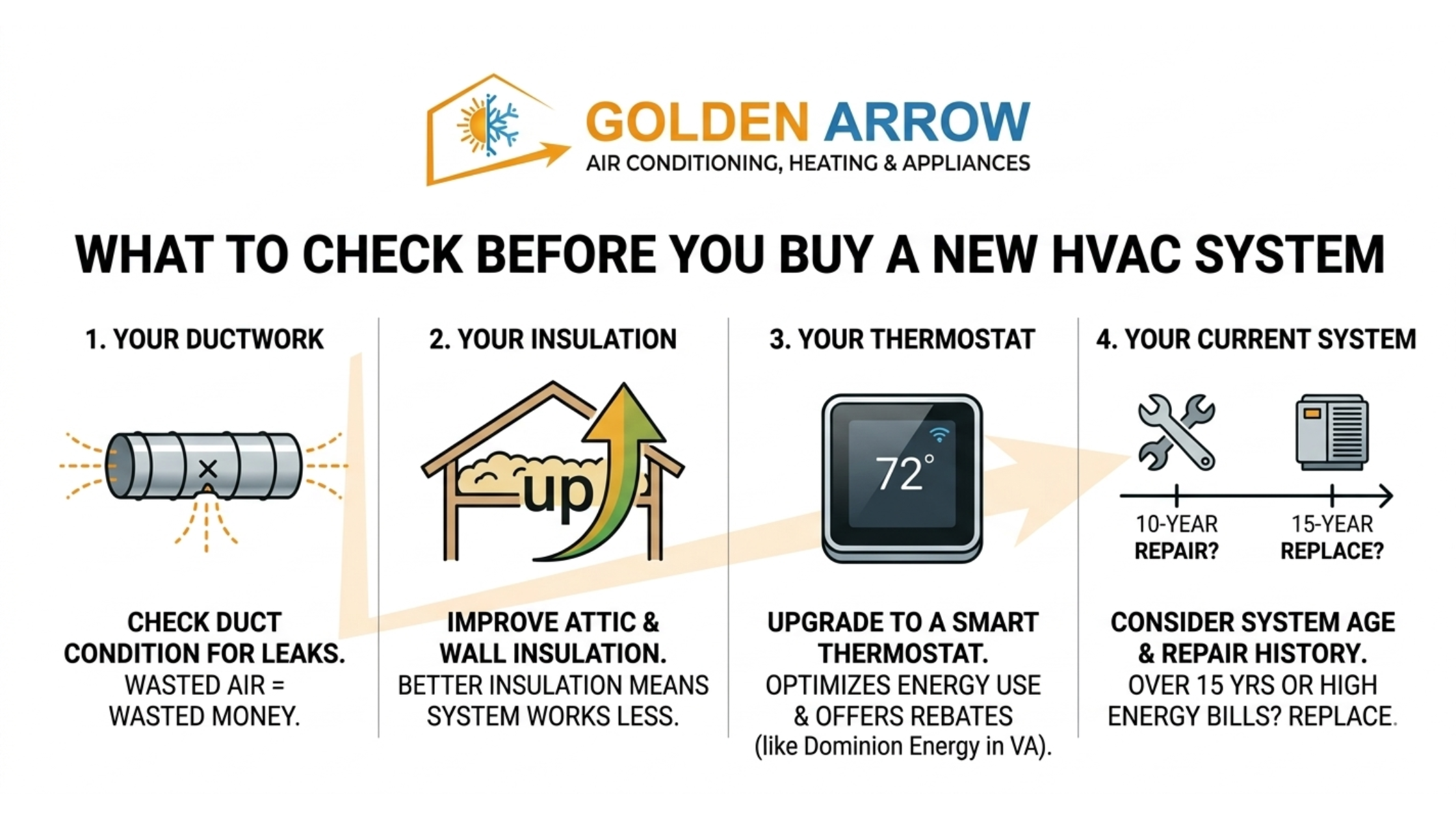
What to Check Before You Buy Anything
A new system won’t fix problems that exist outside the system itself. Here are four things worth looking at first.
Your Ductwork
Old or leaky ducts are one of the most common reasons a new system doesn’t perform as well as expected. If air is leaking out before it reaches the rooms you’re trying to condition, you’re wasting money regardless of how efficient the system is. Ask your technician to check duct condition before installation.
Your Insulation
As mentioned earlier, better insulation means your system works less. If you’re replacing a system that’s been running constantly just to keep up, check the insulation in your attic and walls before assuming you need a bigger system.
Your Thermostat
A new system paired with an old thermostat is a missed opportunity. A smart thermostat learns your schedule, adjusts automatically when you’re away, and can be controlled from your phone. Many programs, including Dominion Energy’s rebate programs in Virginia, offer rebates on smart thermostats that can offset the cost.
Your Current System’s Age and History
If your current system is under 10 years old and has had only minor issues, repair might make more sense than replacement. If it’s over 15 years old, has needed multiple repairs in recent years, or your energy bills have been climbing steadily, replacement is almost always the better financial decision at that point.
Heating System Cost Factors in Northern Virginia
Many homeowners ask, “How much does a new HVAC system cost in 2026?” The honest answer is: it depends on your home. Cost factors include:
- System type
- Equipment size
- Efficiency rating
- Ductwork condition
- Duct sealing needs
- Gas line updates
- Electrical updates
- Propane or oil setup
- Thermostat upgrade
- Permit needs
- Installation complexity
| System Type | Cost Level | Best Value When |
| Gas furnace | Medium | Home already has gas and ducts |
| Heat pump | Medium to high | You need heating and cooling |
| Dual-fuel | High | You want efficiency plus backup |
| Ductless mini-split | Medium to high | You need zoned heating |
| Boiler | Medium to high | Home uses radiators |
| Geothermal | High | Long-term savings matter most |
The cheapest system to install is not always the cheapest to own. Energy bills, repairs, maintenance, and equipment life all matter.
Should You Repair or Replace Your Current Heating System?
When Heating Repair Makes Sense
Repair may make sense if:
- Your system is under 10 years old
- The repair is minor
- Energy bills are normal
- Comfort is still consistent
- Parts are available
- Maintenance has been regular
When Heating Replacement Is the Better Choice
Replacement may be better if:
- The system is 12–15+ years old
- Repairs keep coming back
- Rooms stay cold
- Energy bills keep rising
- The system is unsafe
- You are replacing air conditioning soon
- You want better efficiency
A local HVAC technician can inspect the system and explain whether repair or replacement gives better long-term value.
Why Manual J Load Calculation Matters Before Installation
A Manual J load calculation helps size the right heating system for your home. It reviews:
- Home size
- Insulation
- Windows
- Ceiling height
- Air leaks
- Ductwork
- Local climate
- Existing equipment
A system that is too large may short-cycle. A system that is too small may run too long and still leave rooms cold. Proper sizing protects comfort, energy bills, and equipment life.
Need Help Choosing the Right Heating System in Northern Virginia?
If you are trying to choose the best heating system for your Northern Virginia home, Golden Arrow Service can help compare your options based on home size, ductwork, fuel source, budget, and comfort needs. Golden Arrow Service provides trusted HVAC service in Northern Virginia with same-day service, licensed local technicians, upfront pricing, and no hidden fees.
Frequently Asked Questions About Type of Heating System Northern Virginia
Q1: Can I mix a new heating system with my existing air conditioner?
Sometimes, yes. It depends on your current AC, air handler, ductwork, thermostat, and system compatibility. A technician should check both systems before pairing old and new equipment.
Q2: Do I need a new thermostat when replacing my heating system?
Not always, but many upgrades need a compatible thermostat. Heat pumps, dual-fuel systems, zoned heating, and smart controls may need thermostat updates.
Q3: Will duct sealing really improve heating performance?
Yes, if your ductwork leaks or loses heat in unconditioned areas. Duct sealing can help improve airflow, comfort, and HVAC efficiency.
Q4: Are home electrification rebates available in Virginia?
Some rebates or tax credits may be available for qualifying heat pumps, ENERGY STAR equipment, or electrification upgrades. Program rules change, so check current local and federal options before installation.
Q5: Can one heating system fix uneven rooms?
Not always. Uneven rooms may come from duct problems, insulation gaps, poor airflow, thermostat location, or home layout. Zoned heating or ductless mini-splits may help.
Q6: How long does heating installation usually take?
Many standard furnace or heat pump replacements can be completed in one day. More complex systems, ductwork changes, boilers, or geothermal installations may take longer.
Q7: Should I choose the highest-efficiency system available?
Not automatically. The best choice depends on your budget, home condition, local utility costs, ductwork, and how long you plan to stay in the home.