
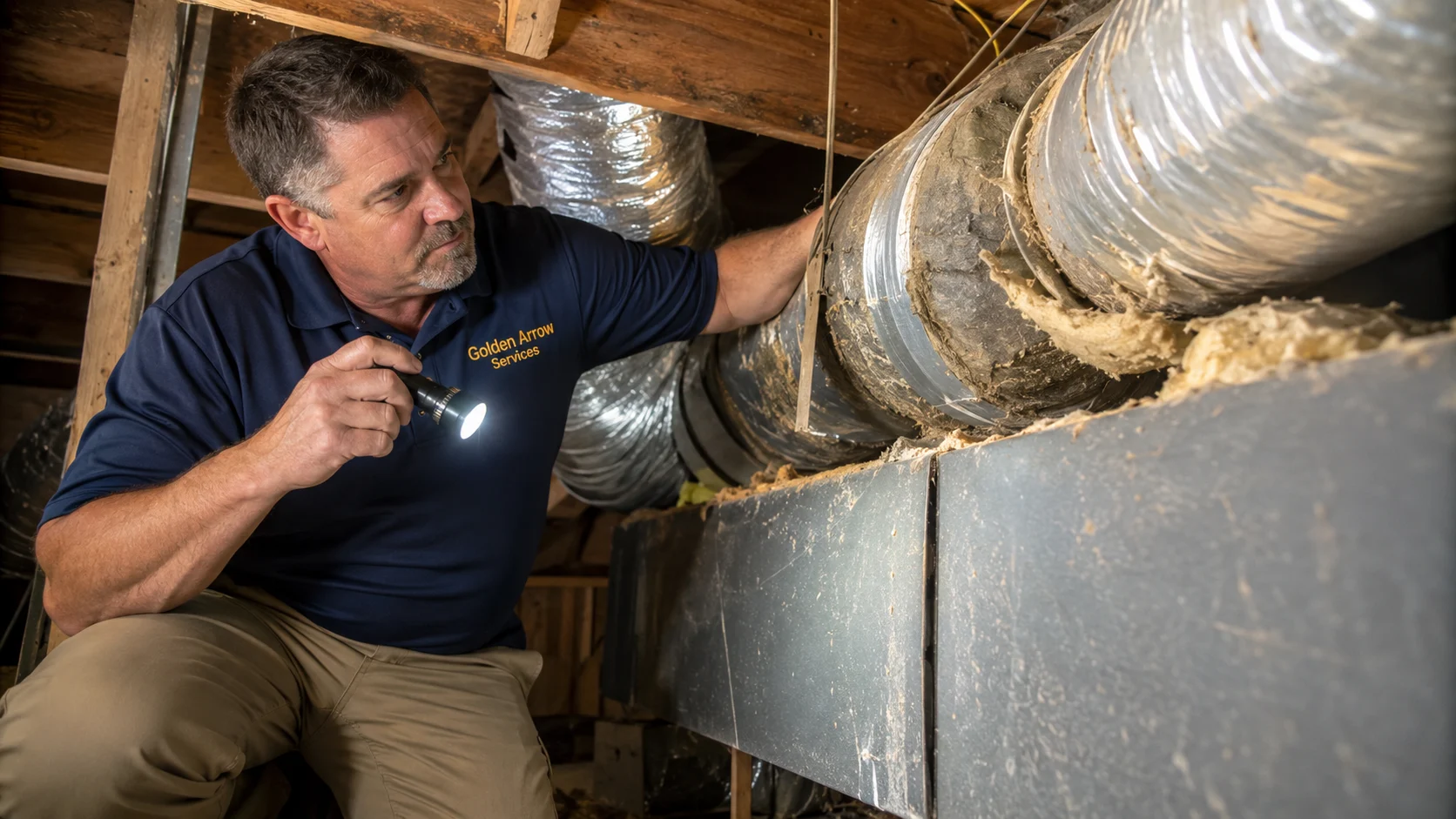
Homes built before 1990 in Vienna, Fairfax, and the rest of Northern Virginia usually have ductwork designed with rule-of-thumb sizing instead of a real load calculation. Add 30 to 50 years of sagging flex duct, leaky joints, and uninsulated attic runs, and the result is uneven temperatures, high energy bills, and dusty rooms. Most of the fixes are straightforward once you know what to look for.
TL;DR
● Ductwork installed before the early 1990s was often sized by square footage, not a proper load calculation, which is why so many older Northern Virginia homes have airflow problems today.
● The most common issues are sagging flex duct, leaky joints, uninsulated attic runs, undersized returns, and corroded metal duct.
●Golden Arrow Service inspects and repairs ductwork throughout Vienna, Fairfax, and Falls Church. Call or text (703) 782-5028 to schedule a duct evaluation.
Fairfax County’s median home was built around 1980, and roughly two out of three houses in the county went up before 1990, according to 2022 American Community Survey data compiled by Point2Homes. Vienna’s average home dates to 1977, based on housing-age mapping from BestNeighborhood.org. That means most homeowners in this area are living with original or near-original ductwork, whether they realize it or not.
That matters because Northern Virginia summers are long, hot, and humid. Ductwork that was undersized or poorly sealed on day one has had three to five decades to get worse. What started as a minor design shortcut in 1975 can turn into a hot second floor, a spiking July electric bill, or a musty smell coming out of the vents today.
Why homes built before 1990 have different duct systems
Ductwork installed before the early 1990s was typically sized using rules of thumb, not a room-by-room calculation, which is a big part of why it underperforms compared to modern systems.
How ductwork was typically sized and installed in this era
Contractors working in the 1960s through the 1980s commonly used a simple square-footage estimate, something like one ton of cooling per 500 to 600 square feet, and ran duct sizes to match. That approach ignores window placement, insulation levels, ceiling height, and how much sun a room gets in the afternoon.
The result is ductwork that was never matched to the actual heating and cooling load of each room. A west-facing bedroom that bakes in the sun by 4 p.m. often got the same size duct run as a shaded room on the north side of the house. Builders also used single, central returns instead of a return in every room, which restricts airflow back to the system and raises static pressure throughout the whole duct network.
What’s different in homes built after the early 1990s
Homes built more recently are more likely to have ductwork sized with a proper load calculation, known in the industry as a Manual J calculation, which accounts for orientation, insulation, and window area room by room. Adoption of this method has grown steadily across the HVAC industry over the past three decades, though it still is not universal even on new construction.
Newer homes also tend to have better duct insulation and more return air pathways built in from the start. None of this means a post-1990 home is problem-free. It just means the starting design was closer to correct, so there is usually less to fix.
Common duct problems in older Northern Virginia homes
The five duct problems Golden Arrow Service sees most often in Vienna and Fairfax homes built before 1990 are sagging flex duct, leaky joints, uninsulated attic runs, undersized returns, and corroded metal duct.
Undersized or sagging flex duct
Flex duct that was not pulled tight and properly supported sags between hangers over time. A sagging run acts like a longer, kinked pipe, which cuts airflow and forces your blower motor to work harder than it should. In a 40-year-old attic, it is common to find flex duct that has crushed itself under its own weight or been crimped by someone crawling past it during an unrelated repair.
[ADD REAL JOB STORY: a specific duct job in Vienna, Fairfax, or Falls Church, what the crew found, what it cost, how it turned out]
Leaky joints and seams
Joints sealed with cloth duct tape decades ago rarely hold up. The adhesive dries out, and the tape peels away from the metal or flex collar, opening a gap that leaks conditioned air straight into your attic or crawl space. Duct leakage is one of the most common reasons a Northern Virginia homeowner sees rising energy bills even though the HVAC system itself is running fine, since a leaky system loses air before it ever reaches a vent.
Uninsulated attic ductwork and summer condensation
Many older Northern Virginia homes have ductwork that runs through an attic with little or no insulation around the duct itself. During July and August, when outdoor humidity is high and attic temperatures can climb well past 120 degrees, cold supply air moving through an uninsulated duct causes condensation on the outside of the metal or flex material. Over years, that moisture problem leads to soaked insulation, mold growth, and even water stains on ceilings below.
Undersized returns causing hot upstairs and uneven temperatures
A single central return, common in homes built before 1990, cannot pull air back to the system fast enough once you add a second story or a finished basement. That imbalance is a big reason upstairs bedrooms in older two-story Vienna and Fairfax homes run several degrees warmer than the main floor, even with the air conditioner working hard.
Corroded or rusted metal ductwork
Metal ductwork exposed to humidity for 30 or more years often develops rust, especially at seams and low points where condensation collects. Rusted duct can flake and introduce particles into your airflow, and severely corroded sections eventually develop holes that leak conditioned air the same way a torn joint does.
Signs your older home’s ductwork needs attention
You do not need to see your ductwork to know something is wrong with it. Watch for these signs:
- One or more rooms are consistently hotter or colder than the rest of the house, especially upstairs bedrooms in summer.
- Your energy bills have crept up over the past few years without a clear reason.
- Dust builds up quickly after cleaning, which often means ducts are pulling in attic or crawl space debris through a leak.
- You hear whistling, rattling, or booming sounds when the system cycles on.
- You can see rust, sagging, or disconnected sections in any exposed ductwork in the attic, basement, or crawl space.
- Your ductwork is original to a home built before 1990 and has never been inspected.
Any one of these on its own is worth a look. Two or three together usually mean it is time to schedule an inspection rather than wait.
Repair or replace? A Northern Virginia decision guide
Most duct problems fall into one of two categories: issues that professional sealing and minor repair can fix, and damage severe enough that replacement is the better long-term value.
|
Situation |
Repair usually makes sense |
Replacement usually makes sense |
| Duct age |
Under 20 years, isolated leaks |
Original to a pre-1990 home, no prior service |
| Damage type |
A few leaky joints or seams |
Widespread sagging, crushed, or disconnected sections |
| Metal condition |
Solid, no visible rust |
Heavy corrosion or holes in multiple sections |
| Airflow complaints |
One or two rooms affected |
Whole house, or entire second floor, runs uneven |
| Insulation |
Intact, just needs sealing |
Missing, wet, or moldy |
If your ducts are mostly sound and the problem is a handful of leaks, sealing restores a meaningful amount of lost efficiency without the cost of a full system swap. If the ductwork is original to a home built decades ago and shows several of the issues above at once, a full or partial replacement usually pays for itself faster in energy savings and comfort than repeated patch repairs.
What duct repair or replacement costs in Northern Virginia
Pricing depends on your home’s size, how accessible the ductwork is, and how much of the system needs work, but Northern Virginia homeowners can expect these general ranges:
- Duct sealing for a whole system: roughly $500 to $2,000
- Targeted repair of a few sections: roughly $500 to $1,500
- Full ductwork replacement for an average home: roughly $3,000 to $7,500
- New duct installation for an addition or finished basement: roughly $1,500 to $4,000
These figures reflect typical project ranges for homes in the Vienna and Fairfax area and will vary based on your specific home. Some Northern Virginia homeowners upgrading ductwork alongside a new HVAC system may also qualify for Dominion Energy efficiency rebates, which can offset part of the cost. A written quote after an in-home inspection is the only way to get an exact number for your house.
Get your ductwork checked in Vienna, Fairfax, or Falls Church
If your Vienna, Fairfax, or Falls Church home was built before 1990 and you are noticing uneven temperatures, rising bills, or dusty rooms, it is worth having the ductwork looked at before you assume you need a new HVAC system. Golden Arrow Service has been installing and repairing ductwork throughout Vienna and the surrounding area for more than 25 years, and we will give you a straight answer about whether sealing, repair, or replacement makes sense for your home. We also handle duct sealing for homes that just need leaks fixed, and if you would rather read about a related issue first, see our guide on how to spot a duct cleaning scam in Northern Virginia.
Golden Arrow Service
8740 Wolf Trap Road, Vienna, VA 22182
Call or text: (703) 782-5028
Find us on Google Maps: https://maps.app.goo.gl/SGtsKxsABCr4U7nm8
Schedule your free duct evaluation and get a written quote before any work starts.
Frequently asked questions
Q1: Can old ductwork make you sick?
Ductwork itself is not usually a direct health hazard, but leaks that pull in attic dust, insulation fibers, or moisture that leads to mold can affect indoor air quality and trigger allergy or asthma symptoms in sensitive household members.
Q2: Is a 12-year-old HVAC system still good if the ductwork is original to a much older home?
Yes, the HVAC equipment and the ductwork are separate systems with separate lifespans. A 12-year-old furnace or air conditioner can still be efficient, but if it is connected to leaky, undersized ductwork from a 1970s or 1980s installation, you will not get the full benefit of that newer equipment until the duct problems are fixed.
Q3: How do I know if my ductwork needs replacing instead of just repairing?
Look at age, damage, and scope together. Ductwork under 20 years old with a couple of isolated leaks is usually a repair. Original ductwork from before 1990 with sagging, corrosion, or leaks in multiple places is usually a better candidate for replacement.
Q4: How long does ductwork actually last in Northern Virginia’s climate? Well-installed metal ductwork can last 25 to 30 years, and flex duct often needs attention sooner, closer to 15 to 20 years, especially in humid attic conditions typical of this area. Original ductwork in a home built before 1990 is well past that range in most cases.
Q5: Do I need a permit to replace ductwork in Fairfax County?
Fairfax County requires mechanical permits for HVAC installation and replacement work. A licensed contractor pulls the required permits as part of the job, and skipping this step can create problems with your homeowner’s insurance or during a future home sale.
Q6: What causes high energy bills even when the HVAC system seems to be working fine?
Duct leakage is one of the most common culprits. Conditioned air escaping through gaps and loose joints means your system runs longer to reach the same temperature, which shows up directly on your utility bill even though the equipment itself is not malfunctioning.
