
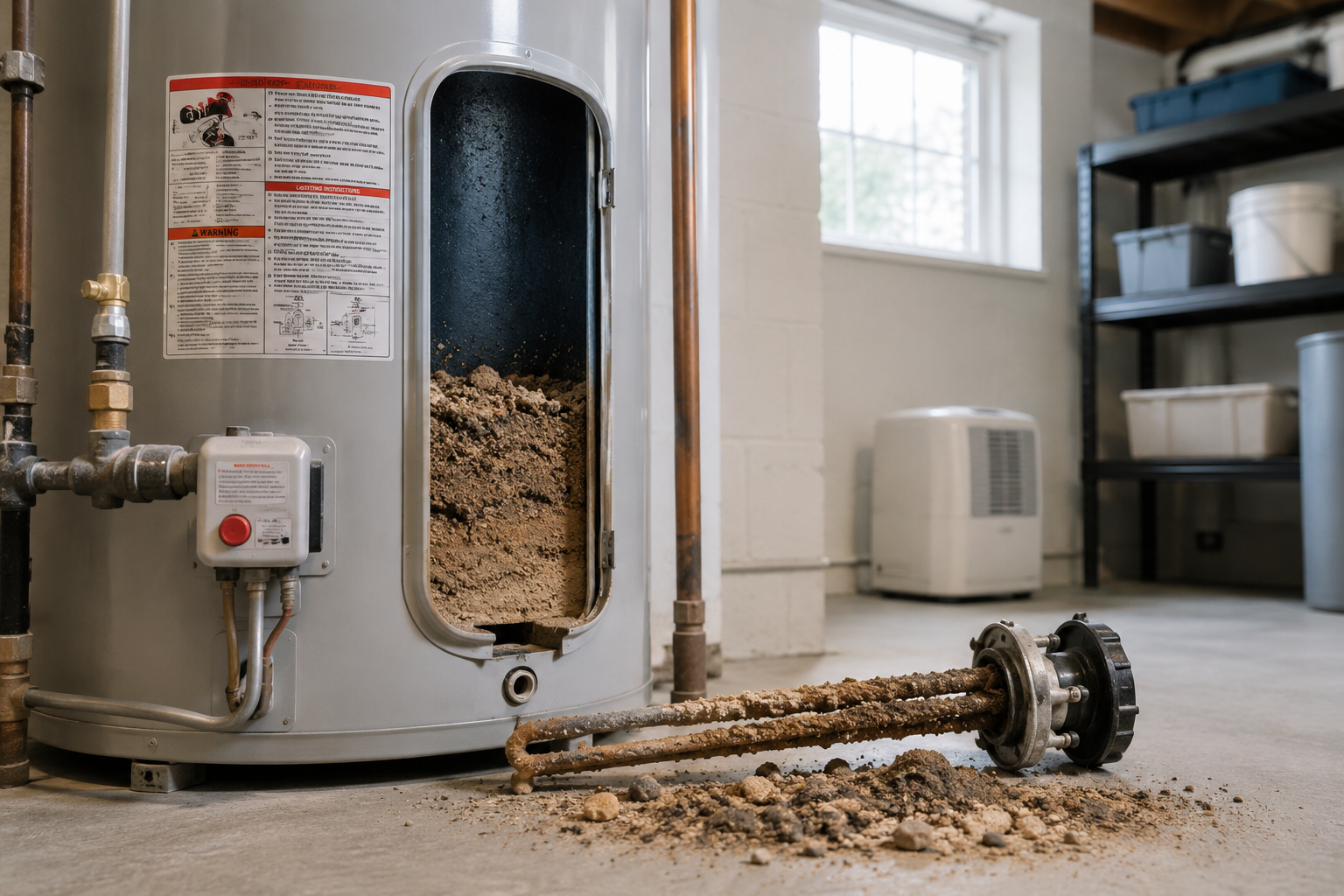

If your water heater is rumbling, popping, or taking longer to deliver hot water, sediment is the most likely cause. Minerals in Northern Virginia’s moderately hard water settle at the bottom of the tank over time, insulating the burner or heating element and forcing the unit to work harder for less hot water. Regular flushing usually clears light to moderate buildup. Heavy, long-neglected sediment often needs a professional inspection before it causes a leak or full tank failure.
Key Takeaways
- Northern Virginia’s water runs 5 to 10 grains per gallon of hardness according to Fairfax Water, which is enough mineral content to build a real sediment layer inside a tank water heater over just a few years.
- Rumbling or popping noises, weaker hot water flow, and rising energy bills are the earliest warning signs. Rusty or gritty water and a tank older than 8 years are signs the buildup has become serious.
- Tank water heaters need a bottom flush to remove sediment. Tankless water heaters need an annual descaling flush instead, since they don’t collect sediment the same way.
- Homes on well water in outer Northern Virginia communities, including Fairfax Station, Clifton, and Great Falls, can see sediment build up faster than homes on Fairfax Water’s municipal supply.
- Flushing costs are typically far lower than a repair, and a repair is typically far lower than replacing a tank that has already been damaged by long-term sediment buildup.
In This Guide
- Why Northern Virginia Homes Are Especially Prone
- Signs of Sediment Buildup, by Severity
- Tank vs. Tankless: Sediment and Scale Are Different Problems
- What Sediment Actually Does to Your Water Heater
- How to Flush Your Water Heater: Step by Step
- What This Costs in Northern Virginia
- When a Flush Isn’t Enough
- How to Prevent Sediment Buildup Going Forward
- Golden Arrow’s Water Heater Service
- FAQ
Why Northern Virginia Homes Are Especially Prone
Sediment is not a defect. It is a natural result of what is dissolved in your water supply. According to Fairfax Water’s official water hardness data, the utility’s treated water measures 5 to 10 grains per gallon (84 to 170 mg/L), sourced from the Potomac River and the Occoquan Reservoir. That level is generally classified as moderately hard. It is not extreme, but it is more than enough calcium and magnesium to form a visible sediment layer inside a tank water heater within a few years, especially once the water is heated repeatedly and the minerals fall out of solution and settle at the bottom of the tank.
Homes on well water in the outer parts of Northern Virginia, including Fairfax Station, Clifton, Great Falls, and parts of Manassas, are not on the Fairfax Water system at all. Well water quality varies property to property depending on the local aquifer, but it commonly carries as much or more dissolved mineral content than municipal water, along with occasional sand or silt that municipal treatment would otherwise filter out. If your home is on a private well, it is worth having your water tested, since sediment buildup in a well-water household can happen faster than the municipal averages above would suggest.
If you have read Golden Arrow’s guide comparing tank and tankless water heaters for Northern Virginia homes, you already know that hard water is a major reason tank water heaters in this region often fail closer to 6.5 years instead of the national 8 to 13 year range. That comparison covers the full tank versus tankless decision. This guide focuses specifically on what sediment does, how to recognize it, and how to deal with it, whichever type of water heater you already have.
Signs of Sediment Buildup, by Severity
Not every sign means the same thing. Matching what you are actually experiencing to a severity level tells you whether a DIY flush is reasonable or whether you should have a technician look at it first.
| Severity | What you’ll notice | What it usually means |
| Light | Faint popping or rumbling during the heating cycle, slightly longer wait for hot water | Early sediment layer, a routine flush should resolve it |
| Moderate | Louder, more frequent popping, noticeably less hot water than before, water bills creeping up, water looking slightly cloudy | Established sediment layer insulating the heating element or burner |
| Heavy | Very little or no hot water, banging or knocking noises, rusty or gritty water at the tap, tank is 8 or more years old | Sediment has likely hardened, may have damaged the drain valve, T&P valve, or tank lining |
A water heater making a popping or rumbling sound during the heating cycle is a textbook sign of trapped water boiling up through a compacted sediment layer, sometimes described as sounding like a percolating coffee maker. That noise alone does not mean the tank is failing. It means sediment has built up enough to trap water underneath it, and a flush is overdue.
Rusty or orange-tinted water is a different signal. It can mean sediment is present, but it can also mean the tank’s internal lining or anode rod is corroding, which sediment tends to accelerate. If you see rust-colored water along with a tank that is 8 years or older, that combination is a heavy-severity sign, not a light one, and it’s worth a professional look before you attempt a DIY flush.
Tank vs. Tankless: Sediment and Scale Are Different Problems
If you have a traditional tank water heater, sediment settles at the bottom of the tank itself, where it insulates the burner or heating element from the water above it. The fix is a bottom flush that drains the tank and clears the loose sediment out through the drain valve.
If you have a tankless water heater, there is no tank for sediment to settle in, but the same hard water minerals coat the inside of the unit’s heat exchanger as scale. Tankless units are actually more sensitive to this than tank units, because the heat exchanger runs at a higher temperature and has far less internal volume to absorb mineral buildup before flow and efficiency are affected. As covered in Golden Arrow’s tank vs. tankless comparison, manufacturers like Rinnai and Navien specifically call for an annual descaling flush in hard water regions like Northern Virginia. Skipping it can shorten a tankless unit’s performance life well before its rated lifespan, which can run up to 20 years with proper maintenance.
In short: tank owners should think in terms of an annual or semiannual flush. Tankless owners should think in terms of an annual descaling service. They solve different problems, but neglecting either one leads to the same outcome, a harder-working, less efficient, shorter-lived water heater.
What Sediment Actually Does to Your Water Heater
Sediment causes damage in a few specific ways, not just one:
- It slows heat transfer. The mineral layer sits between the burner or element and the water, so the unit has to run longer and hotter to reach the same temperature. That’s the direct cause of rising energy bills and a shrinking hot water supply.
- It reduces usable tank capacity. A thick sediment layer at the bottom of the tank takes up space that would otherwise hold hot water, which is part of why a sediment-heavy tank runs out of hot water faster than it used to.
- It stresses the tank and its components. Because the unit has to work harder and run hotter to compensate, that added heat and pressure puts stress on the tank lining, the drain valve, and the pressure relief valve. Over time this can lead to a stuck or clogged drain valve, a malfunctioning pressure relief valve, and in more advanced cases, cracks or corrosion in the tank itself that result in a leak. If your immediate concern is a leak rather than noise or reduced hot water, see Golden Arrow’s guide on what to do if your water heater is leaking, which covers sediment as one of several possible causes alongside valve and connection issues.
How to Flush Your Water Heater: Step by Step
This procedure applies to a standard tank water heater with light to moderate sediment. A.O. Smith’s official water heater draining guidance outlines the same core process manufacturers recommend industry-wide.
- Turn off power or gas. Switch off the circuit breaker for an electric water heater, or turn the gas control valve to “pilot” for a gas unit. Let the tank cool if it was recently used.
- Shut off the cold water supply at the valve feeding the top of the tank.
- Connect a hose to the drain valve near the bottom of the tank and run it to a floor drain, sump, or outside area where hot water can safely drain.
- Open the drain valve and open a hot water tap somewhere in the house to let air into the system so it drains fully.
- Let the tank drain completely, then briefly open the cold water supply in short bursts to stir up and flush out any remaining sediment, continuing until the water runs clear.
- Close the drain valve, disconnect the hose, and refill the tank by turning the cold water supply back on and keeping a hot water tap open until water flows steadily and air is purged from the lines.
- Restore power or relight the pilot and set the thermostat back to your normal temperature.
A word of caution that most generic guides don’t mention: if your tank is 8 years or older and has never been flushed, a hardened layer of sediment can jam the drain valve partway through this process, or the sudden temperature change from fresh cold water can stress an already-weakened tank. For an older, never-flushed unit, it’s worth having a technician handle the first flush rather than risking a stuck valve or a leak on a tank that may already be near the end of its life.
What This Costs in Northern Virginia {#costs}
Exact pricing depends on your unit’s age, access, and condition, and Golden Arrow provides a specific quote after a quick inspection rather than a blanket number over the phone. As a general reference point for the Northern Virginia market, a professional sediment flush typically runs in the lower hundreds of dollars, while a repair involving a damaged drain valve, T&P valve, or anode rod tends to fall in the low to mid hundreds. Replacement becomes the more sensible option once a tank has sustained sediment-related damage to the tank body itself, since a corroded or cracked tank cannot be safely repaired.
The pattern to keep in mind: a flush is the cheapest and most preventable step, a repair is the middle-cost option for damaged components, and replacement is reserved for tanks where sediment has already caused structural damage. Catching the problem at the flush stage is what keeps it from becoming a repair or replacement.
When a Flush Isn’t Enough {#when-flush-isnt-enough}
A flush resolves light to moderate sediment. It will not fix a tank that is already leaking, a drain valve that is stuck or broken, or a unit that is producing rusty water because the tank lining itself has corroded. If you’re dealing with an active leak rather than noise or reduced hot water, Golden Arrow’s guide on water heater leaks in Northern Virginia walks through how to tell where a leak is coming from and whether it’s a repair or a replacement situation.
As a general guideline, replacement becomes the more practical choice when the tank is 10 to 12 years old or older, when it’s already showing rust at the base or seams, or when sediment-related repairs are becoming frequent. At that point, continuing to repair an aging, sediment-damaged tank often costs more over time than replacing it with a properly sized new unit
How to Prevent Sediment Buildup Going Forward
- Flush on a schedule that matches your water. An annual flush is a reasonable baseline for most tank water heaters. Given Northern Virginia’s hardness levels, a semiannual flush, roughly every 6 months, is a more realistic target if you want to stay ahead of buildup rather than reacting to it.
- Descale a tankless unit annually. If you have a tankless water heater, schedule the descaling flush yearly regardless of how the unit sounds or performs, since scale buildup inside the heat exchanger isn’t something you’ll necessarily notice until performance has already dropped.
- Consider a whole-home water softener or filtration system, particularly if you’re on well water or you’ve noticed sediment returning quickly after a flush. Reducing the mineral load before it reaches the water heater cuts down on how often flushing is needed.
- Watch for the early signs, not just the severe ones. A faint popping sound or a slightly longer wait for hot water is easier and cheaper to address than rusty water or a dead water heater.
Golden Arrow’s Water Heater Service
Golden Arrow Service has been serving Northern Virginia homeowners since 1999, and water heater maintenance, flushing, repair, and replacement are part of our regular water heater service work across Vienna, Fairfax, McLean, Arlington, and the surrounding communities. When we flush or inspect a water heater, we check the drain valve, the T&P valve, and the tank condition at the same time, so you know whether you’re looking at routine maintenance or something that needs to be addressed before it becomes a bigger repair.
If your water heater is rumbling, running short on hot water, or you simply can’t remember the last time it was flushed, our licensed technicians can inspect it and give you a straightforward recommendation, whether that’s a flush, a repair, or a replacement, with an upfront quote before any work begins.
Golden Arrow Service 8740 Wolf Trap Road, Vienna, VA 22182 Call or text: (703) 782-5028 Find us on Google Maps: https://maps.app.goo.gl/SGtsKxsABCr4U7nm8
FAQ About Sediment Buildup in Your Water Heater
How often should I flush my water heater in Northern Virginia?
Once a year is a reasonable baseline, but because Northern Virginia’s water runs 5 to 10 grains per gallon of hardness per Fairfax Water, a semiannual flush, about every 6 months, better matches how quickly sediment can build up here compared to areas with softer water.
Can sediment buildup cause a water heater leak?
Yes. As sediment insulates the heating element or burner, the unit works harder and runs hotter to compensate, which stresses the tank lining and can eventually lead to cracks, corrosion, and a leak. If you’re already seeing water around the base of your tank, see our guide on water heater leaks in Northern Virginia to identify the source before assuming it’s sediment alone.
Is well water worse for sediment than city water?
It can be. Homes on Fairfax Water’s municipal supply have a known, treated hardness range of 5 to 10 grains per gallon. Homes on private wells in outer Northern Virginia communities can see more variable and sometimes higher mineral and sediment content depending on the local aquifer, which is one reason well-water households often need more frequent flushing.
Can I flush an old water heater myself?
If the tank is relatively new and has been flushed regularly, a DIY flush following the manufacturer’s steps is generally safe. If the tank is 8 years or older and has never been flushed, a hardened sediment layer can jam the drain valve or stress an aging tank during the process, so it’s worth having a technician handle the first flush.
Does a tankless water heater get sediment buildup too?
Not in the same way. Tankless units don’t have a tank for sediment to settle in, but the same hard water minerals coat the internal heat exchanger as scale, which is why manufacturers like Rinnai and Navien recommend an annual descaling flush instead of a sediment flush.
How much does a water heater flush cost in Northern Virginia?
Pricing depends on your unit and its condition, but a professional flush is typically far less expensive than a repair, and a repair is typically far less expensive than a full replacement. Golden Arrow provides an exact quote after a quick inspection.
About This Guide
This guide was written using Golden Arrow Service’s field experience servicing tank and tankless water heaters across Northern Virginia, along with Fairfax Water’s published water hardness data and A.O. Smith’s manufacturer guidance on water heater draining and maintenance.