
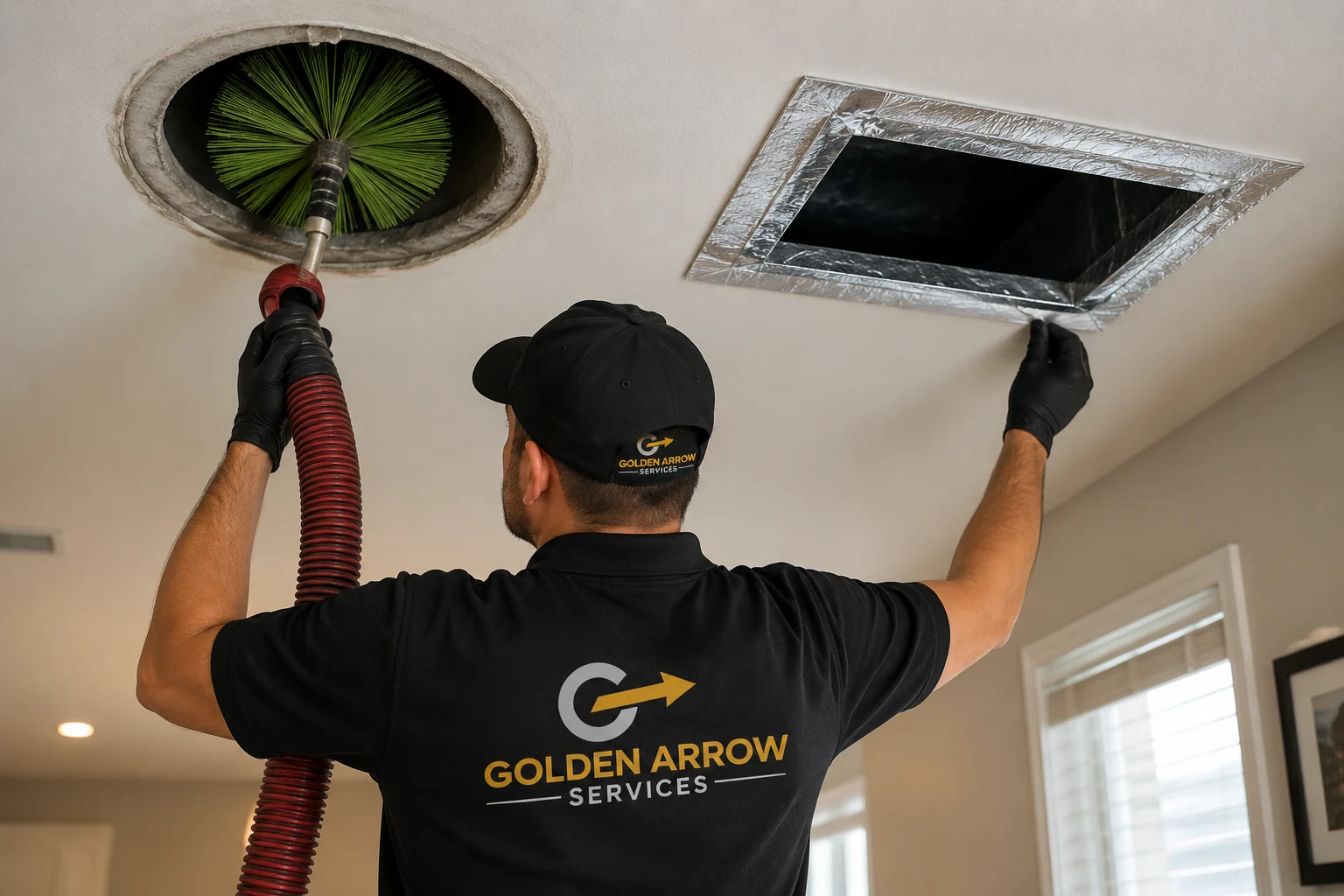

Duct cleaning removes dust, pet dander, and debris from inside your ductwork to improve air quality and airflow. Duct sealing closes gaps, holes, and loose joints in the ductwork itself to stop conditioned air from leaking out before it reaches your rooms. They solve two different problems, and a lot of Northern Virginia homes actually need both — cleaning always comes first if you do.
TL:DR
● Duct cleaning = fixes what’s inside the ducts (dust, allergens, odors). Duct sealing = fixes leaks in the ductwork itself (energy loss, uneven temperatures).
● If you need both, clean first — sealant bonds better to a clean surface.
● The EPA estimates unsealed ducts lose 20–30% of conditioned air before it reaches your rooms.
● NADCA recommends duct cleaning every 3–5 years; a proper duct seal lasts 10–20+ years.
● Homes built before 1990 — the majority in Vienna and Fairfax County — are the most likely to need both. Golden Arrow Service inspects first and tells you which one your home actually needs. Call or text (703) 782-5028.
Quick Answer: Which One Do You Need?
|
Your situation |
Likely fix |
| Dusty vents, musty smell, allergy symptoms indoors, visible debris |
Duct cleaning |
| High energy bills with no usage change, hot/cold rooms, weak airflow |
Duct sealing |
| Recent renovation or new pets |
Duct cleaning |
| Home built before 1990, never inspected |
Both — inspection first |
| Whistling or rattling vents, rooms that never hit thermostat setting |
Duct sealing |
| Visible mold or pest activity in ducts |
Duct cleaning, then seal once clean |
What Is Duct Cleaning?
Duct cleaning is the physical removal of dust, pollen, pet dander, mold spores, and construction debris from inside your supply ducts, return ducts, registers, grilles, and the blower/coil area. Technicians seal off your vents, attach a high-powered vacuum to create negative pressure, then use brushes or compressed-air tools to dislodge buildup so it’s pulled out of the system rather than pushed into your living space.
The National Air Duct Cleaners Association (NADCA) is explicit that “air duct cleaning” is a misnomer — a proper job cleans the entire HVAC system (ducts, coils, drain pan, registers, blower assembly, and air filter housing), not just the visible vent covers. A technician who only wipes down what you can see from the register is not doing a full-system cleaning.
Signs you need duct cleaning:
● Visible dust puffing from vents when the system starts
● A musty or stale smell when the HVAC runs (common after Northern Virginia’s humid summers)
● Allergy or respiratory symptoms that ease up when you leave the house
● Recent renovation, new construction, or new pets
● More than 3–5 years since the last cleaning
What Is Duct Sealing?
Duct sealing repairs the structural leaks in your ductwork — gaps at joints, torn flex duct, disconnected sections, and small holes that let conditioned air escape into an attic, crawl space, or wall cavity before it reaches your rooms. The U.S. EPA and most HVAC efficiency guidance put typical duct leakage at 20–30% of conditioned air in a system that’s never been sealed — meaning your furnace or AC can be running fine and you’re still losing a meaningful chunk of what it produces before it ever reaches a room.
Sealing methods include mastic sealant and metal-backed tape applied at accessible joints, and Aeroseal, which injects an aerosol sealant that finds and plugs leaks from the inside without opening walls. Golden Arrow’s own duct sealing service page breaks down current Vienna-area pricing: standard mastic-and-tape sealing runs roughly $300–$700, a full sealing-plus-insulation upgrade runs $700–$1,500, and whole-home Aeroseal runs $1,500–$3,000, depending on home size and how many leak points are found.
Signs you need duct sealing:
● Energy bills climbed with no change in how you use the system
● Some rooms stay hot or cold no matter what the thermostat says
● Weak airflow at the vents even though the system is running
● Rattling or whistling sounds from ductwork
● Your home was built before 1990 and the ducts have never been inspected
Duct Cleaning vs. Duct Sealing: Side-by-Side Comparison
|
Duct Cleaning |
Duct Sealing |
|
| Problem it solves |
Contamination inside the ducts |
Physical leaks in the ductwork |
| Primary benefit |
Air quality, less dust, fewer odors |
Lower energy bills, even temperatures |
| How often it’s needed |
Every 3–5 years (NADCA guideline) |
Once properly done, lasts 10–20+ years |
| Typical Vienna, VA cost |
Varies by home size and system count |
$300–$3,000 depending on method and scope |
| Methods used |
HEPA vacuums, brushes, air whips |
Mastic sealant, foil tape, Aeroseal |
| Fixes high energy bills? |
Rarely on its own |
Yes — this is its main purpose |
| Fixes dust/allergy symptoms? |
Yes — this is its main purpose |
Only indirectly, by stopping dust intrusion through leaks |
Which Comes First If You Need Both?
Clean first, then seal. Sealant needs a clean surface to bond to — mastic or Aeroseal applied over a duct interior coated in dust and debris won’t adhere as well and can fail sooner. Cleaning first also means you’re not permanently sealing existing contamination inside the system. If an inspection shows your home needs both, expect the technician to clean the system fully before starting any sealing work.
Why Northern Virginia Homes Often Need Both
Roughly two out of three houses in Fairfax County were built before 1990, and Vienna’s average home dates to 1977, based on Point2Homes and BestNeighborhood.org housing-age data. Ductwork from that era was typically sized by a square-footage rule of thumb rather than a room-by-room load calculation, and it’s had three to five decades to develop sagging flex duct, dried-out tape at the joints, and uninsulated attic runs. Our full breakdown of these issues — including a repair-or-replace decision table — is in why older Northern Virginia homes built before 1990 often have duct problems.
Two regional factors make this worse than it would be in a milder, drier climate:
Humid summers accelerate both problems. High humidity feeds mold growth inside dirty ducts and causes condensation on uninsulated ductwork running through hot attics, which is why duct cleaning and duct sealing often get recommended together here more than in drier regions.
Older neighborhoods compound the issue. Homes in Vienna Woods, Windover Heights, and similar 1960s–1980s-era subdivisions frequently show both dusty, contaminated ductwork and leaking joints in the same system, because both problems stem from the same original installation shortcuts.
What a Proper Inspection Should Tell You
Before you commit to either service, a legitimate technician should physically inspect the system and tell you what they actually find — not just recommend both services by default. A duct pressure test (sometimes called a blower door duct test) can quantify leakage as a percentage, which turns “your ducts probably leak” into an actual number you can use to decide whether sealing pays for itself. A visual inspection with a camera or flashlight at accessible joints, paired with a look inside a supply register, tells you whether contamination or structural leaks (or both) are the issue.
How to Verify the Work Was Done Right
After duct cleaning: Ask for a before/after look at the collected debris, confirm the technician cleaned the full system (not just visible vent covers — see the NADCA standard above), and check that any access holes cut into the ductwork were properly resealed. A musty smell should be gone, and dust on furniture should noticeably slow down within a couple of weeks.
After duct sealing: A legitimate sealing job includes a post-service airflow or pressure test so you can see the before-and-after difference in writing, not just take someone’s word for it. Watch your next one or two utility bills against the same month last year, and check whether previously hot or cold rooms even out.
Red Flags to Watch For Before Hiring Either Service
Both duct cleaning and duct sealing attract lowball, high-pressure offers in Northern Virginia — cheap whole-house deals, vague company names, and cash-only pricing are the most common warning signs. We cover this in detail, including a 10-point red-flag checklist and questions to ask before anyone starts work, in how to spot a duct cleaning scam in Northern Virginia. The short version: a legitimate company inspects first, gives you a written scope and price before starting, and explains exactly what’s included.
Duct Problems vs. Other Comfort Issues
Leaky or dirty ductwork can look a lot like other HVAC problems from the homeowner’s side — a room that won’t cool down or a system that seems to run constantly. Before assuming it’s the ductwork, it’s worth ruling out the equipment itself. If your heat pump isn’t heating or cooling properly regardless of duct condition, see our heat pump diagnostic guide. If you’re weighing a full heating system change and wondering whether duct condition should factor into that decision, our gas vs. electric furnace guide for Northern Virginia covers how ductwork condition interacts with system sizing and cost.
Get a Straight Answer for Your Vienna, VA Home
Golden Arrow Service inspects before we recommend anything. If your ducts need cleaning, sealing, both, or neither, we’ll tell you what we actually find and give you a written price before any work starts — no default upsell to both services.
Golden Arrow Service
8740 Wolf Trap Road, Vienna, VA 22182
Call or text: (703) 782-5028
Find us on Google Maps: https://maps.app.goo.gl/SGtsKxsABCr4U7nm8
Frequently Asked Questions
Q1: What’s the difference between duct cleaning and duct sealing?
Duct cleaning removes dust, debris, and contaminants from inside your ductwork. Duct sealing closes physical leaks — gaps, holes, and loose joints — in the ductwork itself. One addresses what’s inside the ducts; the other addresses the ducts’ physical condition.
Q2: Can leaky ducts really affect my energy bill that much?
Yes. Typical unsealed ductwork loses 20–30% of conditioned air before it reaches your rooms, according to EPA guidance on HVAC system performance. That means your system runs longer and harder to reach the same temperature, which shows up directly on your utility bill even when the equipment itself is working fine.
Q3: Should I clean or seal my ducts first if I need both?
Clean first. Sealant bonds better to a clean duct surface, and cleaning first means you’re not sealing existing contamination permanently inside the system.
Q4: How often should ducts be cleaned?
NADCA recommends every 3–5 years for most homes. Homes with pets, allergy sufferers, or a recent renovation may benefit from more frequent cleaning.
Q5: How long does duct sealing last?
Mastic and tape sealing typically lasts 10–15 years; Aeroseal treatments can last considerably longer. Northern Virginia’s humidity and temperature swings can stress duct insulation over time, so pairing sealing with an insulation check gives the best long-term result.
Q6: Is a $99 whole-house duct cleaning offer legitimate?
Not automatically, but it’s a serious red flag when it comes with no inspection, no written scope, and pressure to book immediately. See our full guide on spotting duct cleaning scams in Northern Virginia before booking any surprisingly cheap offer.