
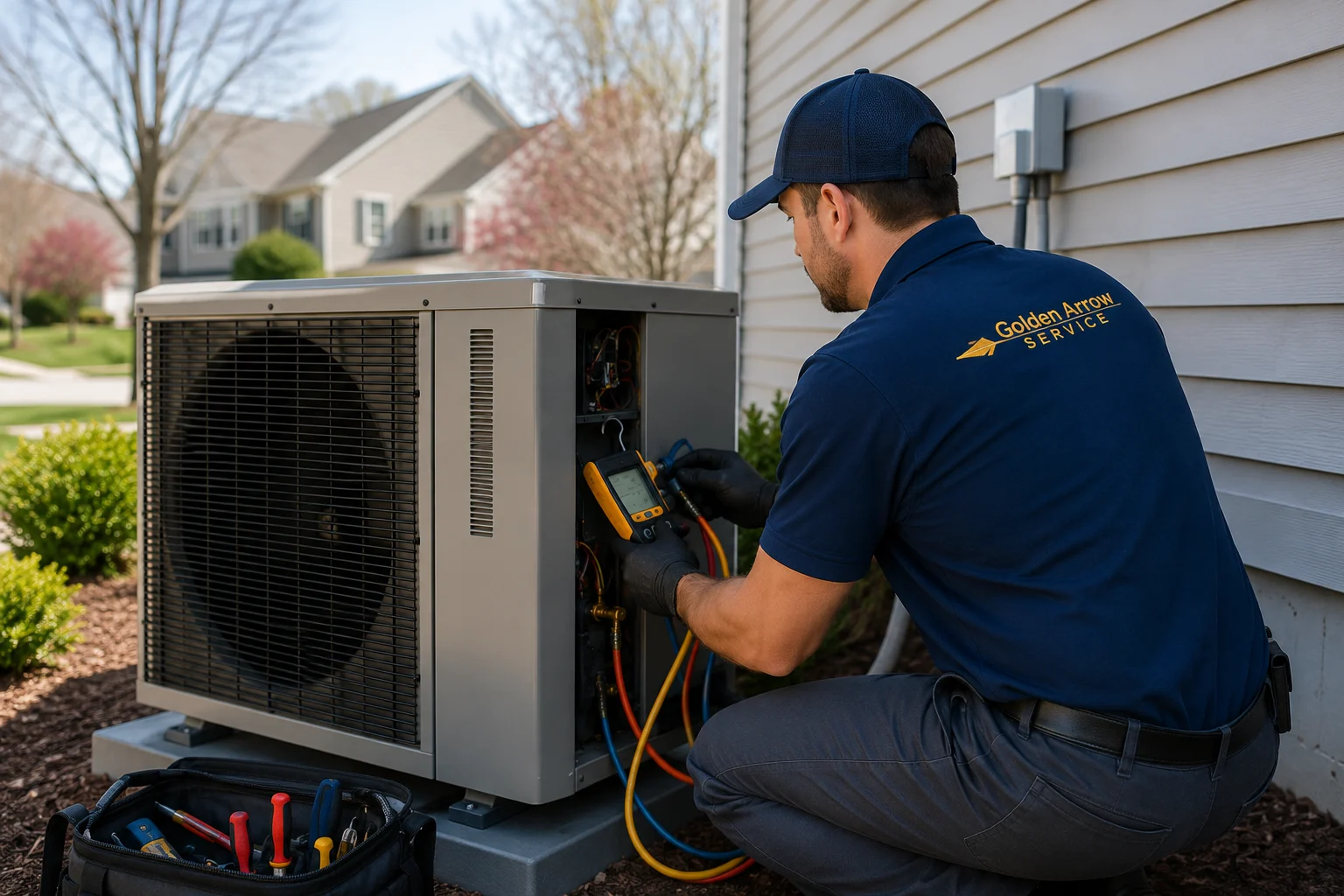
Your heat pump runs, but the house won’t warm up in January or cool down in July. Before you assume the worst, it helps to know that most heat pump problems trace back to a short list of causes, and several of them you can check in a few minutes without any tools.
A heat pump that won’t heat or cool properly usually comes down to one of a few things: a dirty air filter, a wrong thermostat setting, a tripped breaker, low refrigerant, or a stuck reversing valve. A few of these you can fix yourself. The rest need a licensed technician to diagnose safely.
TL;DR
- Start with the easy checks: thermostat mode, air filter, breaker panel, and clearance around the outdoor unit. These solve a large share of “not heating or cooling” calls.
- Some symptoms point to bigger problems. Low refrigerant, a stuck reversing valve, or a frozen coil need professional diagnosis, not a DIY fix.
- If the basics don’t fix it, Golden Arrow Service offers same-day heat pump repair across Vienna and Northern Virginia, 7 days a week. Call or text (703) 782-5028.
Fast diagnosis: match your symptom to the likely cause
The quickest way to diagnose a heat pump is to start with the symptom you’re seeing, then work toward the cause. The table below points you to the most likely culprits. Use it as a shortcut, since more than one cause can produce the same symptom.
|
What you’re seeing |
Most likely causes |
| Blowing cool air when set to heat |
Wrong thermostat mode, normal defrost, dirty filter, stuck reversing valve |
| Blowing warm air when set to cool |
Stuck reversing valve, thermostat set wrong, low refrigerant |
| Runs constantly but never reaches temperature |
Dirty filter, low refrigerant, dirty outdoor coil |
| No air from the vents at all |
Tripped breaker, indoor power switch off, blower fault |
| Ice or frost on the outdoor unit |
Normal defrost, low refrigerant, low airflow |
| Turns on and off every few minutes |
Short cycling from thermostat, airflow, or refrigerant |
| Water pooling by the indoor unit |
Clogged condensate drain, thawed frozen coil |
Before you rule causes in or out, it’s worth confirming the heat pump is actually malfunctioning, because one of the most common “problems” in Northern Virginia homes turns out to be the system working exactly as designed.
Is your heat pump actually broken, or just working normally?
Sometimes a heat pump that feels weak is doing exactly what it’s designed to do. As the U.S. Department of Energy explains, a heat pump moves heat rather than burning fuel to create it, so the air from your vents comes out warm rather than hot. It typically lands in the 85 to 95°F range, which feels cool against your skin at 98.6°F even while it steadily heats the room.
|
Heat pump (winter) |
Gas furnace |
|
| Supply air temperature |
Roughly 85 to 95°F |
Often 110°F and up |
| How it feels at the vent |
Warm, sometimes cool to the touch |
Distinctly hot |
| How it heats |
Gradual, steady |
Fast blasts |
So if your home still reaches the temperature you set and the air just feels lukewarm, your heat pump is likely fine. If the house genuinely won’t warm up, or the air blows cold, that’s a real fault, and the heating problems below are where to start.
Heat pump not heating: causes and how to diagnose it
When a heat pump won’t heat, the cause is almost always one of seven things, from a thermostat setting you fix in seconds to a refrigerant leak that needs a technician. Work through them from easiest to most serious.
Wrong thermostat setting. Confirm the thermostat is set to “heat,” the target is a few degrees above the room, and the fan is on “auto,” not “on.” A fan on “on” blows unheated air between cycles and feels cold. Replace the batteries if it uses them.
Dirty air filter. A clogged filter is the single most common cause. It chokes airflow, so the house won’t warm and the coil can freeze. Check it monthly.
Tripped breaker or indoor power switch. A heat pump uses two breakers, one for the outdoor unit and one for the indoor air handler. Reset any that tripped. The air handler also has its own switch that should be “on.”
Frozen outdoor unit. Light frost is normal in winter. A thick coat of ice that never melts usually means low airflow or low refrigerant.
Low refrigerant. If the system runs nonstop and still can’t keep up, it may be low on refrigerant, almost always from a leak. This needs a professional to find, repair, and recharge. Topping it off without fixing the leak solves nothing.
Stuck reversing valve. The reversing valve switches the system between heating and cooling. If your heat pump cools fine but won’t heat, a stuck valve is the likely reason, and it’s a professional repair.
Failed auxiliary heat strips. In deep cold, backup electric heat strips kick in. If they’ve failed, the system struggles on the coldest Northern Virginia nights, which is an electrical diagnosis for a technician.
If the fix points to refrigerant, the reversing valve, or the heat strips, Golden Arrow Service handles those heat pump repairs with same-day service. Call or text (703) 782-5028. If your system heats fine but won’t cool, the causes shift a little.
Heat pump not cooling: causes and how to diagnose it
When a heat pump won’t cool in summer, the causes overlap with heating but show up differently. Here’s what to check.
Dirty air filter or frozen coil. Restricted airflow from a clogged filter can freeze the indoor coil, which blocks cooling entirely. Swap the filter and let a frozen coil thaw before running the system again.
Dirty or blocked outdoor condenser. The outdoor unit sheds heat, so it needs room to breathe. Clear leaves, grass, and debris, and keep at least two feet of clearance on all sides.
Low refrigerant. Weak cooling that gets worse over a season usually signals a refrigerant leak, which is a professional repair, not a recharge.
Reversing valve stuck in heat mode. If warm air blows when you’ve set the thermostat to cool, the reversing valve may be stuck. A technician confirms and repairs it.
Thermostat set wrong. Confirm “cool” mode, a target below room temperature, and fresh batteries before assuming a mechanical fault.
Humid Northern Virginia summers. During the region’s humid, 90-plus-degree stretches, a marginal or undersized system simply can’t keep up, and small issues like a dirty coil get exposed fast. If cooling lags every July, have the system’s capacity and charge checked.
Heat pump blowing cold air in winter: is it the defrost cycle?
A heat pump that briefly blows cool air in winter is usually running a normal defrost cycle, not breaking down. To melt frost off the outdoor coil, the system reverses for about 5 to 15 minutes, so indoor air feels cooler and you may see steam outside. That’s normal and it stops on its own.
It becomes a problem when the outdoor unit stays coated in thick ice, gets stuck in defrost, or blows cold air constantly. Those point to low refrigerant, a failing defrost control, or airflow issues that a technician should inspect.
Other heat pump warning signs worth diagnosing
Not every heat pump problem shows up as weak heating or cooling. A few other symptoms are worth knowing. If the system won’t turn on at all, start at the breaker panel and the indoor power switch. If it short cycles, turning on and off every few minutes, the cause is usually a thermostat, airflow, or refrigerant issue. Water pooling near the indoor unit often means a clogged condensate drain or a coil that froze and thawed. And a burning or musty smell, or a loud grinding or squealing noise, means you should shut the system off and call a professional right away.
Heat pump troubleshooting you can do yourself
Before you book a service call, five safe checks resolve a large share of heat pump complaints. Do these first.
- Set the thermostat correctly. Right mode, target temperature past the room reading, fan on “auto,” fresh batteries.
- Replace the air filter. The Department of Energy recommends changing filters about every three months.
- Clear the outdoor unit. With the power off, remove leaves, snow, and debris, and keep two feet of clearance around it.
- Reset tripped breakers. Check both the indoor and outdoor circuits.
- Test emergency heat. If backup heat warms the house, the fault is in the heat pump itself, not the power supply.
One safety rule: if you smell gas or burning, hear grinding, or see sparks, stop and call a professional. Everything past these basics is where a technician earns their keep.
When to call a professional for heat pump repair
Call a licensed technician when the problem involves refrigerant, the reversing valve, electrical components, or persistent ice, or when your DIY checks didn’t fix it. Refrigerant is regulated and requires certification to handle. A burning smell, a grinding noise, water damage, or a breaker that keeps tripping all warrant professional diagnosis rather than another reset. Golden Arrow Service diagnoses and repairs these issues the same day across Northern Virginia.
Should you repair or replace your heat pump?
Repair usually makes sense until a heat pump is near the end of its life, then replacement wins. Most systems last about 12 to 15 years. If yours is in that range, needs frequent repairs, or is driving up energy bills, replacement often costs less over time than repeated fixes. A newer system also cools and heats more efficiently through Northern Virginia’s swings between humid summers and cold snaps. If you’re weighing options, our guide on choosing between a heat pump and a furnace can help you decide before you spend on another repair.
Same-day heat pump repair in Vienna and Northern Virginia
If your heat pump still won’t heat or cool properly after the basics, Golden Arrow Service can help today. We’ve served Northern Virginia homeowners for over 25 years with licensed technicians, same-day service 7 days a week, no evening or weekend surcharge, and a free second opinion. We cover Vienna, Fairfax, Arlington, Reston, McLean, and nearby communities.
Book your same-day heat pump diagnosis:
Golden Arrow Service
8740 Wolf Trap Road, Vienna, VA 22182
Call or text: (703) 782-5028
Find us on Google Maps: https://maps.app.goo.gl/SGtsKxsABCr4U7nm8
Prefer to write to us first? Reach the team through our contact page and we’ll respond quickly.
Heat pump FAQ
Q1: Why is my heat pump running but not heating the house?
Usually a dirty air filter, a wrong thermostat setting, or low refrigerant. Check the filter and thermostat first. If it still runs nonstop without warming up, have a technician check the refrigerant charge.
Q2: Why is my heat pump blowing cold air when the heat is on?
Most often it’s a normal defrost cycle that lasts 5 to 15 minutes. If the cold air is constant, suspect a wrong thermostat setting, a dirty filter, or a stuck reversing valve.
Q3: Why is my heat pump not cooling in summer?
Common causes are a clogged filter, a dirty outdoor coil, low refrigerant, or a reversing valve stuck in heat mode. During humid Northern Virginia heat, an undersized or low-charge system also struggles to keep up.
Q4: Is ice on my heat pump normal in winter?
Light frost is normal, and the defrost cycle clears it. Thick ice that never melts is not normal and usually means low refrigerant or an airflow problem.
Q5: How long should a heat pump defrost cycle last?
About 5 to 15 minutes. If your system stays in defrost far longer or cycles into it constantly, have it inspected.
Q6: Can I fix a heat pump myself, or do I need a pro?
You can safely handle thermostat settings, filter changes, clearing the outdoor unit, and resetting breakers. Refrigerant, reversing valve, and electrical repairs require a licensed technician.
Q7: How much does heat pump repair cost in Northern Virginia?
It depends on the part and the problem, from minor thermostat or sensor fixes to larger refrigerant or component repairs. Golden Arrow Service gives an upfront quote before any work, so you approve the price first. Call (703) 782-5028 for a free estimate.
