
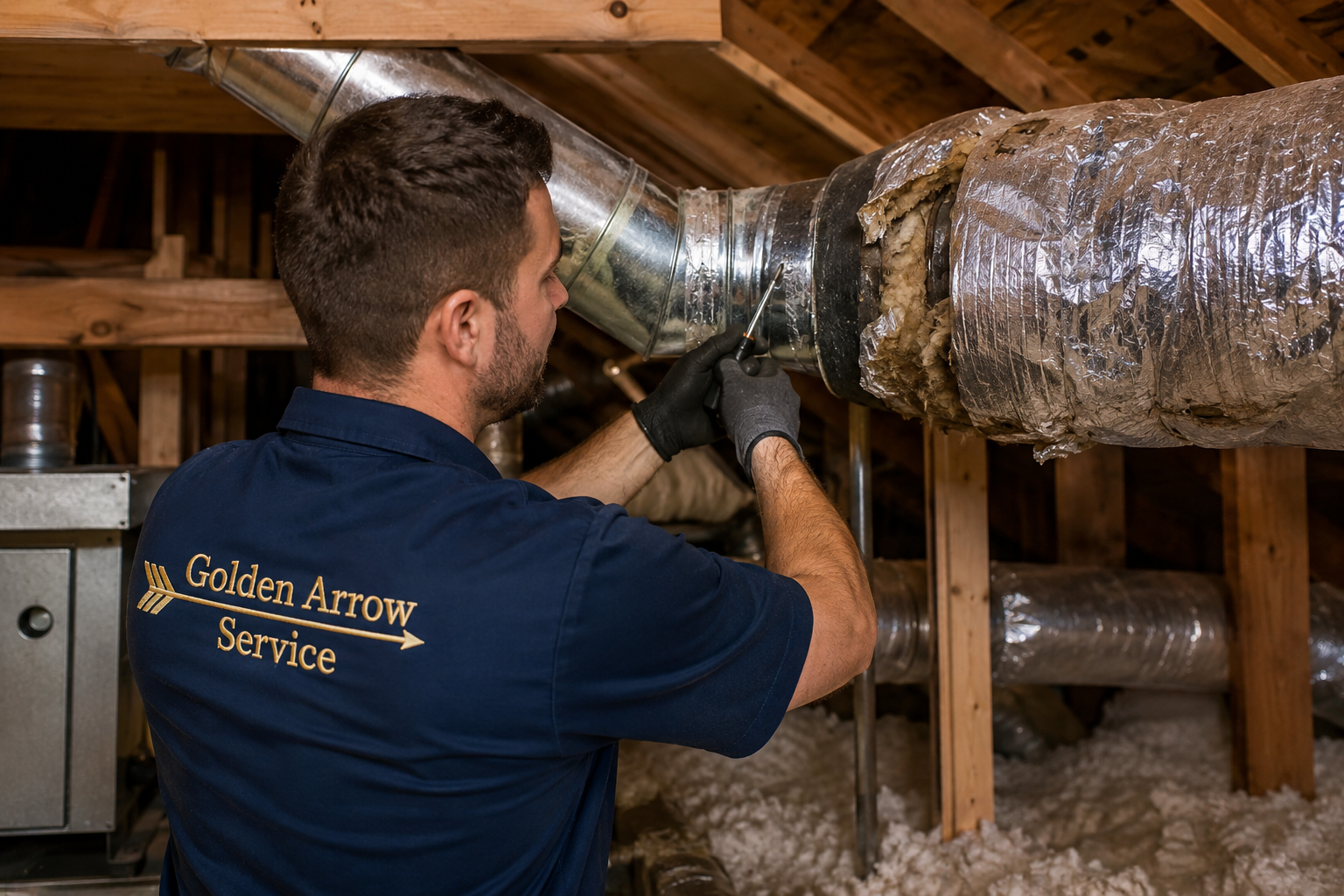
Your furnace and air conditioner get all the attention, but the air ducts hiding in your attic, crawl space, and walls decide how much of that heated or cooled air actually reaches your rooms. Most homes need new ductwork when the system is 15+ years old, leaking conditioned air, contaminated with mold, or no longer matched to the HVAC equipment. In Northern Virginia—where thousands of homes in Fairfax, Arlington, Loudoun, and Prince William counties were built during the 1980s and 1990s—much of that original ductwork is now past its expected lifespan. Here are the warning signs, including the subtle ones most homeowners overlook.
The Quick Answer: When Does a Home Need New Ductwork?
A home typically needs new ductwork when the ducts are more than 15–20 years old, show physical damage like rust, sagging, or crushed sections, leak enough air to cause hot and cold rooms or rising energy bills, or contain mold that cleaning cannot remove. If problems persist after HVAC maintenance and duct sealing, air duct replacement is usually the smarter long-term investment.
How Long Does Ductwork Last in Northern Virginia Homes?
Most residential ductwork lasts 10 to 25 years, depending on the material, installation quality, and where the ducts run. Here’s what we typically see in Northern Virginia homes:
|
Duct Type |
Typical Lifespan |
Common In |
| Sheet metal (galvanized steel) |
20–25+ years |
Older colonials, basements |
| Flexible (flex) duct |
10–15 years |
Attic runs, 1990s–2000s builds |
| Duct board / fiberglass |
10–20 years |
Builder-grade installations |
Two local factors shorten those numbers. First, housing age: a large share of Northern Virginia’s housing stock went up during the building booms of the 1980s and 1990s. If your home still has its original ducts, they’re now 25–40 years old—well beyond the design life of flex duct and duct board. Second, humidity: our muggy summers cause condensation on uninsulated or poorly insulated ducts in attics and crawl spaces. That moisture quietly rusts sheet metal, degrades insulation, and invites mold—damage that progresses for years before anyone notices.
The Warning Signs Most Homeowners Already Know
Some symptoms of failing HVAC ductwork are hard to miss, and most articles cover them:
- Rising energy bills without a change in usage—according to the U.S. Department of Energy, ducts that leak heated air into unheated spaces can add hundreds of dollars a year to your heating and cooling bills
- Uneven heating and cooling, with one room too hot while another stays cold
- Rattling, banging, or whistling noises as air pushes through loose joints and small holes
- Excess dust that returns days after you clean
If you’re seeing several of these, your ducts deserve a professional inspection. But the costlier failures usually announce themselves more quietly—through the signs below.
6 Ductwork Warning Signs Northern Virginia Homeowners Often Ignore
These are the symptoms our technicians find during inspections that homeowners rarely connect to their air ducts.
1. Your Air Filter Turns Grey Within Weeks
A filter that clogs unusually fast often means return ducts are pulling unfiltered air—and insulation fibers, attic dust, and crawl space debris—through gaps and disconnected joints. You’re not just buying filters more often; your family is breathing what the filter can’t catch.
2. Humidity Problems Even Though Your AC Works Fine
If your home feels sticky in summer or you spot condensation on vents and windows while the air conditioner runs normally, leaky return ducts may be drawing humid outdoor or crawl space air into the system. In Northern Virginia’s climate, this is one of the most common hidden duct problems we diagnose.
3. Allergies That Flare Up in Specific Rooms
When sneezing, coughing, or asthma symptoms get worse in one bedroom but not the rest of the house, the duct run serving that room may be contaminated or pulling in allergens from an unconditioned space. Whole-house air purifiers can’t fix a duct that’s feeding pollutants into a single room.
4. Condensation, Rust, or Mold on Visible Ducts
Take a flashlight into your attic, basement, or crawl space. Water stains, rust streaks, dark spots, or musty odors around duct surfaces signal moisture intrusion. Mold in air ducts is a health concern, and the EPA advises that wet or moldy insulated ductwork should be replaced rather than cleaned, because the insulation cannot be effectively decontaminated.
5. A New Furnace or AC Didn’t Improve Comfort
This one frustrates homeowners the most. You invested in a high-efficiency AC or furnace, yet rooms still feel uneven and bills barely dropped. Older duct systems were often undersized or poorly routed for modern HVAC equipment, so the new unit can’t deliver the airflow it was designed for. Pairing new equipment with 30-year-old ducts is like putting new tires on bent rims.
6. Whistling or Pressure Changes When Doors Close
If closing a bedroom door causes whistling at the gap or makes the door hard to shut while the system runs, your home has a pressure imbalance—usually from inadequate return air paths or leaking supply runs. Over time, this strains the blower motor and shortens equipment life.
Duct Repair vs Replacement: How to Decide
Not every duct problem requires full ductwork replacement. Minor damage in younger systems can often be handled with targeted duct repair. Use this framework:
|
Situation |
Best Option |
| Ducts under ~15 years old with a few isolated leaks |
Repair and seal the affected sections |
| Structurally sound ducts with many small leaks |
Professional duct sealing (Aeroseal) |
| Ducts 20+ years old, rusted, crushed, or sagging |
Replacement |
| Mold-contaminated insulated ducts |
Replacement (per EPA guidance) |
| Undersized ducts paired with new HVAC equipment |
Redesign and replacement |
For leak-driven problems in otherwise healthy ducts, Aeroseal duct sealing is often the middle path: a non-toxic sealant travels through the system and closes gaps from the inside, even in ducts buried inside walls. Many homeowners cut heating and cooling losses dramatically this way—learn more on our duct sealing service page.
When damage, age, or design problems go beyond what sealing can fix, replacement pays for itself through lower bills, balanced comfort, healthier air, and longer HVAC equipment life.
What Happens During Ductwork Replacement?
Knowing what to expect makes the decision easier. A professional air duct replacement in a Northern Virginia home follows five steps:
- Inspection and airflow testing. A technician examines every accessible duct run, measures static pressure and airflow, and identifies leaks, damage, and design problems.
- System design. New ducts are sized to your home’s layout and your HVAC equipment’s airflow requirements—not simply copied from the old layout, which may have been wrong from day one.
- Removal of old ductwork. Old runs are disconnected and removed, with vents sealed off so dust and debris don’t spread through your living space.
- Installation and sealing. New ducts are cut, fitted, connected, and sealed at every joint, then insulated where they pass through attics and crawl spaces.
- Testing and balancing. Airflow is verified room by room so every space gets the heating and cooling it was designed to receive.
Most single-family homes are finished in one to three days, and you can stay in your home during the work.
How Much Does Ductwork Replacement Cost in Northern Virginia?
Nationally, full ductwork replacement averages roughly $1,900 to $17,000+, with most single-family projects landing in the middle of that range. The spread is wide because cost depends far more on your home’s layout than its size:
|
Cost Factor |
Why It Matters |
| Linear feet of duct |
Long ranch layouts need more duct than compact two-story homes |
| Access |
Open basements cost less than tight attics and crawl spaces |
| Material |
Sheet metal costs more than flex duct but lasts longer |
| Vents and returns |
Each register requires its own run |
| Permits |
Requirements vary by county and city in Northern Virginia |
The only way to get a real number is an in-home inspection—duct systems are too individual for online calculators. Be cautious of any quote given over the phone without measuring your home.
What You Gain From New Ductwork
Replacing failing ducts isn’t just damage control—it upgrades the whole system:
- Lower energy bills. Conditioned air reaches your rooms instead of escaping into the attic, so your HVAC system runs shorter cycles.
- Even temperatures. Properly sized and routed ducts end the battle between hot upstairs bedrooms and cold basement offices.
- Healthier indoor air. Sealed ducts stop pulling dust, insulation fibers, and allergens from unconditioned spaces.
- Longer equipment life. Correct airflow reduces strain on the blower motor, heat exchanger, and compressor.
- Quieter operation. Tight connections and correct sizing eliminate rattles, bangs, and whistles.
Suspect Your Ductwork? Get a Professional Inspection
Ductwork problems rarely fix themselves—they quietly raise your bills and wear out your equipment year after year. If you’ve noticed any of the signs above in your Northern Virginia home, Golden Arrow Service can inspect your duct system, measure airflow, and give you an honest recommendation: repair, seal, or replace.
Our technicians install, seal, and replace ductwork throughout Fairfax, Arlington, Loudoun, and Prince William counties. Explore our duct installation services or call us at (703) 782-5028 to schedule your ductwork inspection.
Frequently Asked Questions
Q1: How long does ductwork replacement take?
For a typical single-family home, one to three days, depending on access and the number of duct runs.
Q2: Should I replace ductwork when installing a new HVAC system?
If your ducts are 15+ years old or were sized for older equipment, yes—replacing both together ensures the new system delivers its rated efficiency and avoids paying for attic or crawl space access twice.
Q3: Can moldy air ducts just be cleaned?
Bare sheet metal can sometimes be professionally cleaned and treated, but the EPA recommends replacing insulated ductwork that has gotten wet or moldy, since contamination penetrates the insulation.
Q4: Will sealing my ducts lower my energy bills?
Usually, yes. Sealing leaky ducts commonly reduces heating and cooling waste by 20% or more, since leaks can dump conditioned air into attics and crawl spaces instead of your rooms.
Q5: Do I need a permit to replace ductwork in Northern Virginia?
Most counties and cities in Northern Virginia require mechanical permits for duct replacement. A licensed HVAC contractor handles the permit and inspection process for you.
