
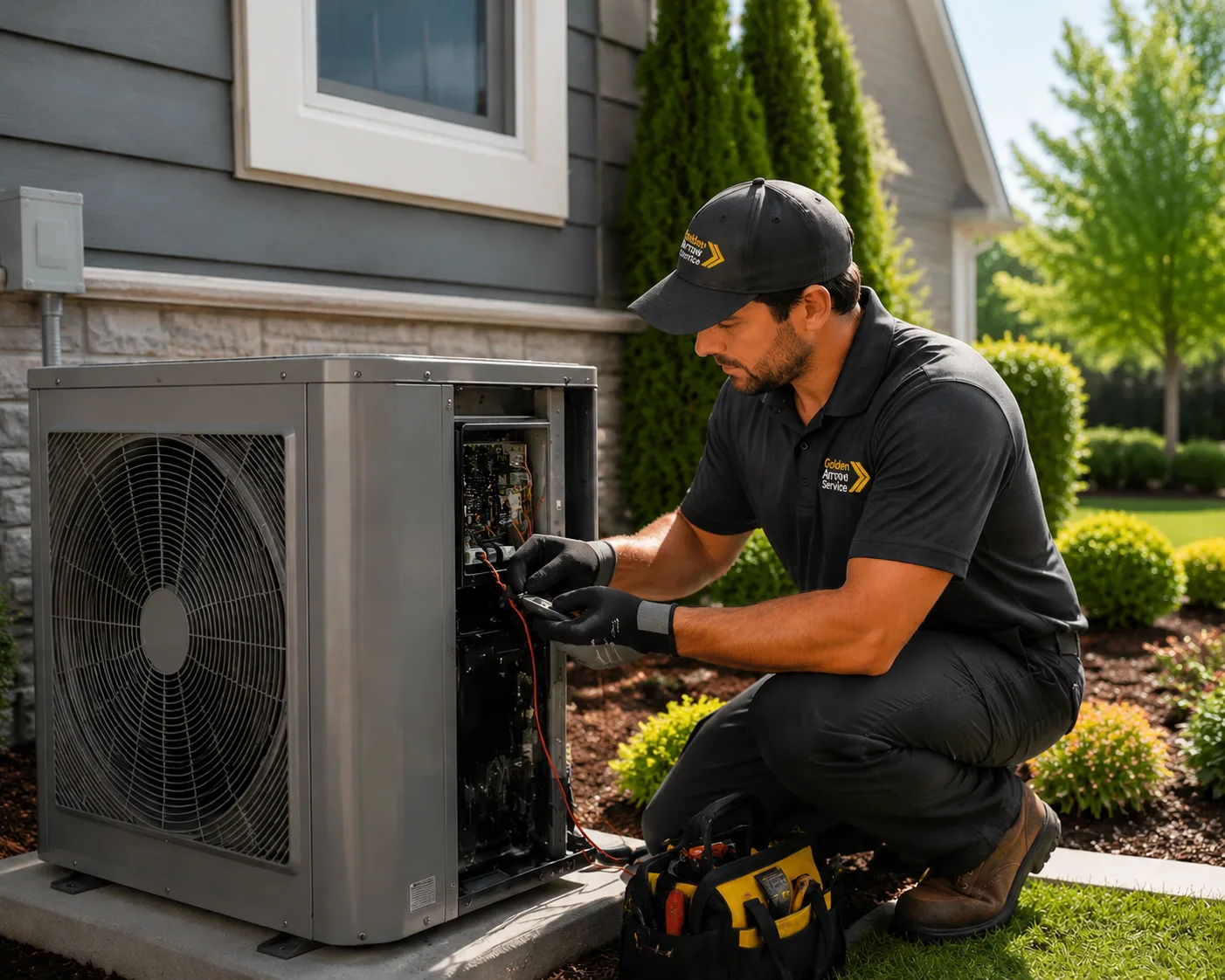

By the Golden Arrow Service team — family-owned HVAC in Vienna, VA, serving Northern Virginia for 25+ years
Yes — for most Northern Virginia homes, a heat pump is an excellent fit. Our region’s mild, four-season climate sits right in a heat pump’s efficient operating range for the large majority of the year, so it can heat and cool your home from one system while cutting energy use compared to a traditional furnace-and-AC setup. It’s the best fit for homes with electric heat, existing ductwork, or anyone planning to replace both heating and cooling at once. Here’s everything you need to decide.
What Is a Heat Pump?
A heat pump is a single system that both heats and cools your home by moving heat rather than generating it. Instead of burning fuel like a furnace, it uses electricity and refrigerant to transfer heat from one place to another — pulling warmth out of your home in summer and pulling it in from the outside air in winter.
Because moving heat takes far less energy than creating it, a heat pump can deliver two to four times more heat energy than the electricity it consumes during mild conditions.
How Does a Heat Pump Work?
A heat pump runs on a refrigerant cycle. In heating mode, the outdoor coil absorbs heat from the outside air — yes, even cold air holds usable heat — and the refrigerant carries that heat indoors, where it’s released into your home. A compressor raises the refrigerant’s temperature along the way so it can give off plenty of warmth even when it’s chilly outside. The U.S. Department of Energy has a clear breakdown of how heat pump systems work if you want the deeper science.
How a Heat Pump Heats AND Cools
The magic is a part called the reversing valve. Flip it, and the refrigerant flow runs the other direction — now the system pulls heat out of your indoor air and dumps it outside, working exactly like a central air conditioner. One unit, two jobs, year-round comfort. That’s why many Northern Virginia homeowners like that a heat pump replaces both the furnace and the AC.
Types of Heat Pumps
There are three main types worth knowing:
- Air-source heat pump — the most common and affordable. It works with your existing ductwork and is the right choice for most homes here.
- Ductless mini-split — perfect for additions, finished basements, or rooms without ductwork. Learn more about our ductless split system service.
- Geothermal heat pump — pulls heat from the ground for rock-steady, ultra-efficient performance, but costs the most to install. See our geothermal heating and cooling options.
Do Heat Pumps Work in Northern Virginia’s Climate?
Northern Virginia gives a heat pump close to ideal conditions. Our summers are hot and humid, and our winters are mostly mild with only short cold snaps — so across Fairfax, Loudoun, Arlington, and Prince William County, the vast majority of winter days fall inside a heat pump’s efficient range. The old reputation that “heat pumps only work in warm climates” is outdated.
Do Heat Pumps Work in Cold Weather?
They do. Modern cold-climate heat pumps keep heating effectively well below freezing — many maintain output down to around -15°F, far colder than a typical Vienna or Centreville winter night. Even in the cold, they run with a coefficient of performance (COP) above one, meaning they still deliver more heat energy than the electricity they use. Units with variable-speed compressors hold their efficiency best when temperatures drop.
Backup and Dual-Fuel Heat for Cold Snaps
For the few truly frigid days we get, heat pumps pair with a backup heat source so you’re never left cold. Most air-source systems include electric auxiliary (strip) heat that kicks in automatically during extreme cold. A dual-fuel system takes it further — it pairs a heat pump with a gas furnace, running the efficient heat pump most of the season and switching to gas only on the coldest days. For homes that already have gas, this is often the smartest setup in our climate.
Heat Pump vs. Gas Furnace in Northern Virginia
Here’s how a heat pump stacks up against the traditional options:
|
Feature |
Heat Pump |
Gas Furnace + AC |
Electric Furnace + AC |
| Heats & cools in one system |
Yes |
No (two units) |
No (two units) |
| Upfront cost |
Moderate |
Moderate–High |
Lower |
| Running cost (NoVA) |
Lowest in mild weather |
Low if gas is cheap |
Highest |
| Best in extreme cold |
Needs backup |
Excellent |
Good |
| Lifespan |
10–15 yrs (up to 20) |
15–20 yrs furnace |
20+ yrs furnace |
| Carbon footprint |
Lowest |
Higher |
Moderate |
Which Is Cheaper to Run? The Virginia Price-Ratio Math
The deciding factor is your electricity-to-gas price ratio. At typical Virginia rates — roughly $0.12 per kWh for electricity and about $1.70 per therm for natural gas — a modern high-efficiency heat pump is generally cheaper to run than even a 95% efficient gas furnace. The rule of thumb: if your electricity-to-gas ratio is below about 3.5 to 1, the heat pump usually wins on operating cost. Virginia’s relatively low electricity prices put most homes here on the heat-pump side of that line. If you’re weighing furnace types specifically, our guide to gas furnace vs. electric furnace for a Northern Virginia home goes deeper.
How Much Does a Heat Pump Cost in Northern Virginia?
For most Northern Virginia homes, installing a heat pump runs about $3,900 to $10,400 for a 2-to-5-ton system, removal and installation included. A typical replacement — a 3-ton unit for a 1,500–2,100 sq ft house — lands around $5,000 to $6,700.
What Affects the Price
Your final number depends on a few things: the size (tonnage) your home needs, the condition of your existing ductwork, and the system’s efficiency ratings (SEER2 for cooling, HSPF2 for heating — higher numbers mean more efficiency and a higher price). Premium brands and variable-speed models cost more upfront but save more over time. The only way to know your real cost is an in-home assessment — request a free quote and we’ll give you upfront pricing with no hidden fees.
Rebates, Tax Credits & Incentives (2026 Update)
Incentives changed recently, so here’s the accurate 2026 picture:
- Federal air-source heat pump tax credit (25C): This credit expired on December 31, 2025, so new air-source installs no longer qualify for the federal credit.
- Geothermal heat pumps: Still eligible for a 30% federal tax credit through 2032 — a major reason geothermal is worth a look for the right home.
- Virginia utility rebates: Local utilities still offer rebates (for example, Appalachian Power’s efficient-products program), and state energy-efficiency rebate programs may help qualifying households. Check Virginia Energy Sense for current programs.
Incentives shift often — we help our customers identify which ones they currently qualify for before installation.
What Size Heat Pump Do I Need?
A common rule of thumb is 20–30 BTU per square foot of living space. In practice, a 30,000 BTU unit (a 2.5-ton system) generally covers a 1,000–1,500 sq ft home under average conditions.
But that’s only a starting estimate. Right-sizing actually depends on your insulation, ceiling height, windows, and sun exposure — which is why a proper Manual J load calculation matters. An oversized unit short-cycles, struggles with humidity, and wears out faster; an undersized one can’t keep up. Sizing by guesswork is the most common installation mistake we fix.
How Long Do Heat Pumps Last + Maintenance
A heat pump typically lasts 10 to 15 years, and with good care it can reach 20 years or more. Because it runs year-round (heating and cooling), regular maintenance matters more than it does for a furnace.
A simple upkeep checklist:
- Replace or clean air filters every 1–3 months.
- Keep the outdoor unit clear of leaves, grass, and snow.
- Schedule professional maintenance twice a year — before summer and before winter.
- Watch for warning signs: rising bills, weak airflow, odd noises, or constant cycling.
Is a Heat Pump Right for YOUR Home?
A heat pump is likely a great fit if you can check these boxes:
- Fuel type: You heat with electricity now, or you want to move away from fossil fuels.
- Ductwork: You have existing ducts (for a central system) — or you’re open to a ductless option if you don’t.
- Budget: You’re replacing both heating and cooling, so one system that does both makes financial sense.
- Efficiency goals: Lower energy use and a smaller carbon footprint matter to you.
One quick note on equipment level: single-stage units are the most basic and budget-friendly, two-stage units improve comfort and humidity control, and variable-speed units deliver the steadiest temperatures and quietest operation — a real advantage in Northern Virginia’s swingy shoulder seasons. We’ll help you match the right tier to your home and budget.
Golden Arrow Service — Heat Pump Installation in Northern Virginia
For over 25 years, Golden Arrow Service has helped homeowners across Northern Virginia stay comfortable, with a 4.8-star average customer rating. Our licensed, insured technicians install, replace, and repair heat pumps throughout Vienna, Fairfax, Centreville, Chantilly, Arlington, and the surrounding Fairfax, Loudoun, and Prince William County areas — with same-day service, upfront pricing, and no extra charge for evenings or weekends.
Thinking about whether a heat pump is right for your home? We’ll size it properly, walk you through your options, and give you a no-obligation estimate..
.
Golden Arrow Service
8740 Wolf Trap Road, Vienna, VA 22182
📞 Phone: (703) 782-5028
Email: info@goldenarrowservice.com
Find us on Google Map: https://maps.app.goo.gl/sW3eJrmTr6bKVAYw6
Frequently Asked Questions
Q1: Do heat pumps work in Virginia winters?
Yes. Northern Virginia’s winters are mostly mild, and modern heat pumps heat efficiently well below freezing. On the few extreme-cold days, backup or dual-fuel heat takes over automatically, so your home stays comfortable.
Q2: Is a heat pump cheaper than a furnace in Virginia?
Usually, yes. At typical Virginia electricity and gas rates, a high-efficiency heat pump is generally cheaper to run than a gas furnace, because it moves heat instead of burning fuel and delivers far more energy than it consumes.
Q3: How much does a heat pump cost in Northern Virginia?
Most installations run $3,900–$10,400 depending on size, with a typical 3-ton replacement around $5,000–$6,700. Ductwork condition and efficiency rating affect the final price.
Q4: What size heat pump do I need?
A rough guide is 20–30 BTU per square foot (a 2.5-ton unit covers ~1,000–1,500 sq ft), but accurate sizing requires a Manual J load calculation based on your specific home.
Q5: Are there heat pump rebates in Virginia in 2026?
The federal air-source tax credit expires at the end of 2025, but geothermal systems still earn a 30% federal credit through 2032, and Virginia utility and state efficiency rebates may apply.
Q7: How long does a heat pump last?
Typically 10–15 years, and up to 20 with regular maintenance and filter changes.