
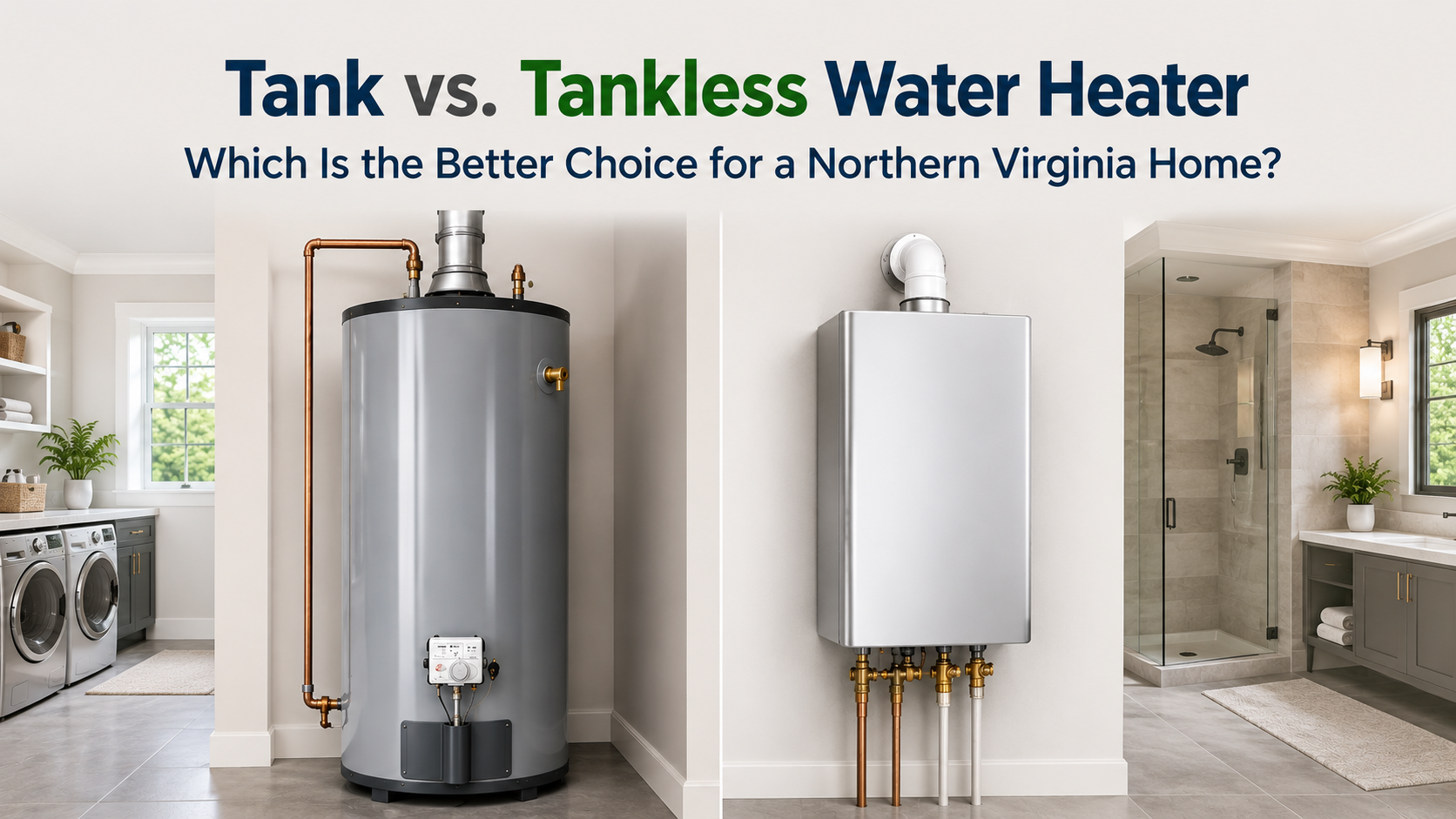
A tank water heater costs less upfront, usually $2,100 to $3,200 installed, and drops into your existing setup with no extra work. A tankless unit runs $4,000 to $7,500 or more, but it lasts almost twice as long and handles Northern Virginia’s hard water better when you keep up with maintenance. The tank vs. tankless water heater decision really comes down to your gas line, your electrical panel, and how many people are showering before 8 a.m.
The short version:
- Tank water heaters cost less to install but typically last 8 to 13 years, less in hard water, and carry a real flood risk if they fail.
- Tankless units cost more upfront, last 15 to 20+ years, and deliver endless hot water, but need a gas line and electrical capacity older Vienna and Fairfax County homes don’t always have.
- Not sure which one fits your house? Call Golden Arrow Service at 703-782-5028 and we’ll check your setup before you spend a dollar.
Tank vs. tankless at a glance
| What matters most to you | Tank | Tankless |
| Lower price today | Wins | |
| Lifespan and long-term cost | Wins | |
| Hard water durability | Wins, with annual descaling | |
| No house upgrades needed | Wins | |
| Flood and leak risk | Wins, minimal standing water | |
| Keeps working in a power outage | Wins, with a standard pilot light | |
| Resale value | Wins | |
| Install time | Wins, faster swap |
My family keeps running out of hot water. Will either type fix that?
It depends on size, not type. A 50-gallon tank refills slowly once it’s empty, so back-to-back showers in a four-person Vienna household can drain it before everyone’s done. A correctly sized tankless unit solves that by heating water on demand instead of storing it, but “correctly sized” matters more than the marketing suggests.
A family of four typically needs 8 to 10 gallons per minute (GPM) from a gas tankless unit, or 20 to 28 kW from an electric one. Run two showers and a dishwasher at the same time, though, and even a well-sized gas unit can hit its limit. That’s not a defect. It’s physics: most gas tankless heaters deliver 2 to 5 GPM, and a single shower alone uses 2 to 2.5 GPM. If your household regularly stacks demand like that, you may need a higher-BTU unit or a second point-of-use heater for a remote bathroom.
Is the higher tankless price tag actually worth it, or will I just lose money?
It pays off over time for most households, but the math depends on how long you stay in the house. Installed costs in Northern Virginia run $2,100 to $3,200 for a gas tank, $2,100 to $2,900 for an electric tank, $4,000 to $7,500-plus for gas tankless, and $2,800 to $4,500 for electric tankless.
Tankless installs often carry add-ons that contractors don’t always mention upfront: $800 to $2,000 for a gas line upgrade, $200 to $500 for code-compliance items like expansion tanks, and $80 to $300-plus in permit fees depending on your jurisdiction. Rebates offset some of that. Washington Gas offers up to $400, Virginia Natural Gas offers $150 to $300, and a federal tax credit can return another $300 to $600.
Warranties tell the rest of the story. A standard tank carries a 6-year warranty on the unit and 1 year on labor. A tankless unit typically carries a 12-year warranty on the heat exchanger, 5 years on parts, and 1 year on labor, backing up that longer lifespan with real coverage.
Will Northern Virginia’s hard water wreck my new system before it pays for itself?
It will shorten a tank’s life noticeably, and it will void a tankless warranty if you skip maintenance. Vienna and the rest of Fairfax County run on Fairfax Water, which measures 5 to 10 grains per gallon of hardness, enough to coat heating elements and tank interiors with calcium and magnesium scale. That mineral buildup is a big reason tank water heaters in this area often fail closer to 6.5 years instead of the national 8-to-13-year range.
Tankless units handle hard water differently, but they’re not immune. Rinnai and Navien, two of the most common brands installed in this area, both require annual descaling to keep the warranty valid. Skip it, and scale builds up inside the heat exchanger, cutting efficiency and shortening the unit’s life regardless of what the warranty paperwork says.
Can my older Vienna home handle a tankless unit without a big upgrade?
Maybe not without one. Most homes built in the 1970s through 1990s in Fairfax County were plumbed with a 1/2-inch gas line, but tankless units need 140,000 to 200,000 BTU per hour, which typically requires a 3/4-inch line at minimum. If your house still has the original gas line, budget for that upgrade as part of the install, not as a surprise afterward.
Electric tankless units bring their own catch. They often need 150 to 200 amp electrical service, and a lot of older Northern Virginia homes only have 100 to 150 amps on the panel. Upgrading the panel to support that runs $3,000 to $6,000 on top of the unit itself, which can erase a good chunk of the long-term savings you were counting on. The same gas-line and panel questions come up when comparing a gas furnace vs. electric furnace for the rest of the house.
What if my tank bursts in the basement? Am I risking real damage?
Yes, and it’s more common than most homeowners think. Water damage is the single most frequent category of homeowners insurance claim, and a failed water heater is one of the leading causes. Corrosion and a worn anode rod weaken the tank over years until it ruptures, and once that happens, repair and cleanup typically runs $5,000 to $15,000 once you factor in flooring, drywall, and mold remediation. Mold can start forming within 24 to 48 hours of a flood.
Tankless units largely sidestep this risk. They hold only a small amount of water in the heat exchanger at any time, so a failure produces a drip, not a flood. If your tank is approaching 8 years old, that risk alone is worth weighing against the cost of switching.
Why does it still take forever for hot water to reach my shower?
That delay, sometimes called a cold water sandwich, happens on both tank and tankless systems, and it has nothing to do with which type you own. Hot water sitting in the pipes cools after a few minutes, so the next time you turn on the tap, you get a slug of lukewarm or cold water before the heater catches up. In a two-story Vienna home with a water heater in the basement and a shower upstairs, that wait can stretch past a minute.
A recirculating pump fixes this by keeping hot water moving through the pipes so it’s already at the fixture when you turn the tap. Demand-controlled versions, triggered by a switch in the bathroom, avoid running the pump around the clock and wasting energy.
What happens to my hot water during a power outage?
A standard tank with a gas pilot light keeps producing hot water through an outage, since it doesn’t rely on electricity to ignite. Electric tankless units, and even gas tankless units, need power for their ignition and control systems, so both go cold the moment the lights go out. If outages are a real concern for your property, a tank with pilot-light ignition has a clear edge here. Our heat pump vs. furnace comparison covers the same outage tradeoff in more depth.
Will this decision help or hurt me when I sell my house?
It can help. Homes that sold with a tankless water heater installed went for roughly 4% over their expected value and sold 43 days faster, according to industry resale data. In a market like Vienna and the rest of Fairfax County, where mechanical upgrades carry real weight with buyers, that’s not a small number.
What actually happens on installation day, and how long am I without hot water?
A straightforward tankless-to-tankless swap takes 2 to 4 hours. Converting from a tank to tankless for the first time takes longer, typically 6 to 10 hours, because of the added gas line, venting, and electrical work. Permit fees vary by jurisdiction: Fairfax County runs $80 to $120, while other Northern Virginia counties can run $150 to $300 or more depending on the scope of work.
Golden Arrow Service’s water heater installation and repair team handles the permit process, the gas and electrical work, and the final inspection as part of every installation, so you’re not the one coordinating with the county.
Frequently asked questions about Tank vs. tankless water heater
Q1;Is a tankless water heater worth it in Vienna, VA?
For most households planning to stay in their home more than 5 to 7 years, yes. The higher upfront cost is offset by a longer lifespan, lower flood risk, and resale value, especially once rebates and tax credits are applied.
Q2; How long do tank vs. tankless water heaters last in Virginia?
Tank water heaters typically last 8 to 13 years nationally, but closer to 6.5 years in Fairfax County’s hard water. Tankless units last 15 to 20 years or more with annual descaling.
Q3: Will a tankless water heater work with Fairfax County’s hard water?
Yes, but only with regular maintenance. Fairfax Water measures 5 to 10 grains per gallon, and most manufacturers require annual descaling to keep the warranty valid.
Q4; Do I need to upgrade my electrical panel for an electric tankless water heater?
Possibly. Electric tankless units often need 150 to 200 amp service, and many older Northern Virginia homes only have 100 to 150 amps, which means a panel upgrade costing $3,000 to $6,000.
Q5; What size tankless water heater do I need for a family of four?
Most four-person households need 8 to 10 GPM from a gas unit or 20 to 28 kW from an electric one, though simultaneous high-demand use like two showers and a dishwasher can push past that.
Q6; Does switching to tankless increase my home’s resale value?
Industry data shows homes with tankless water heaters have sold for about 4% over expected value and 43 days faster, which matters in a high-value market like Vienna.
Still weighing tank versus tankless for your Vienna home? Golden Arrow Service can check your gas line and panel capacity and give you real numbers before you decide. Call 703-782-5028 or schedule a visit online and we’ll take it from there.
