
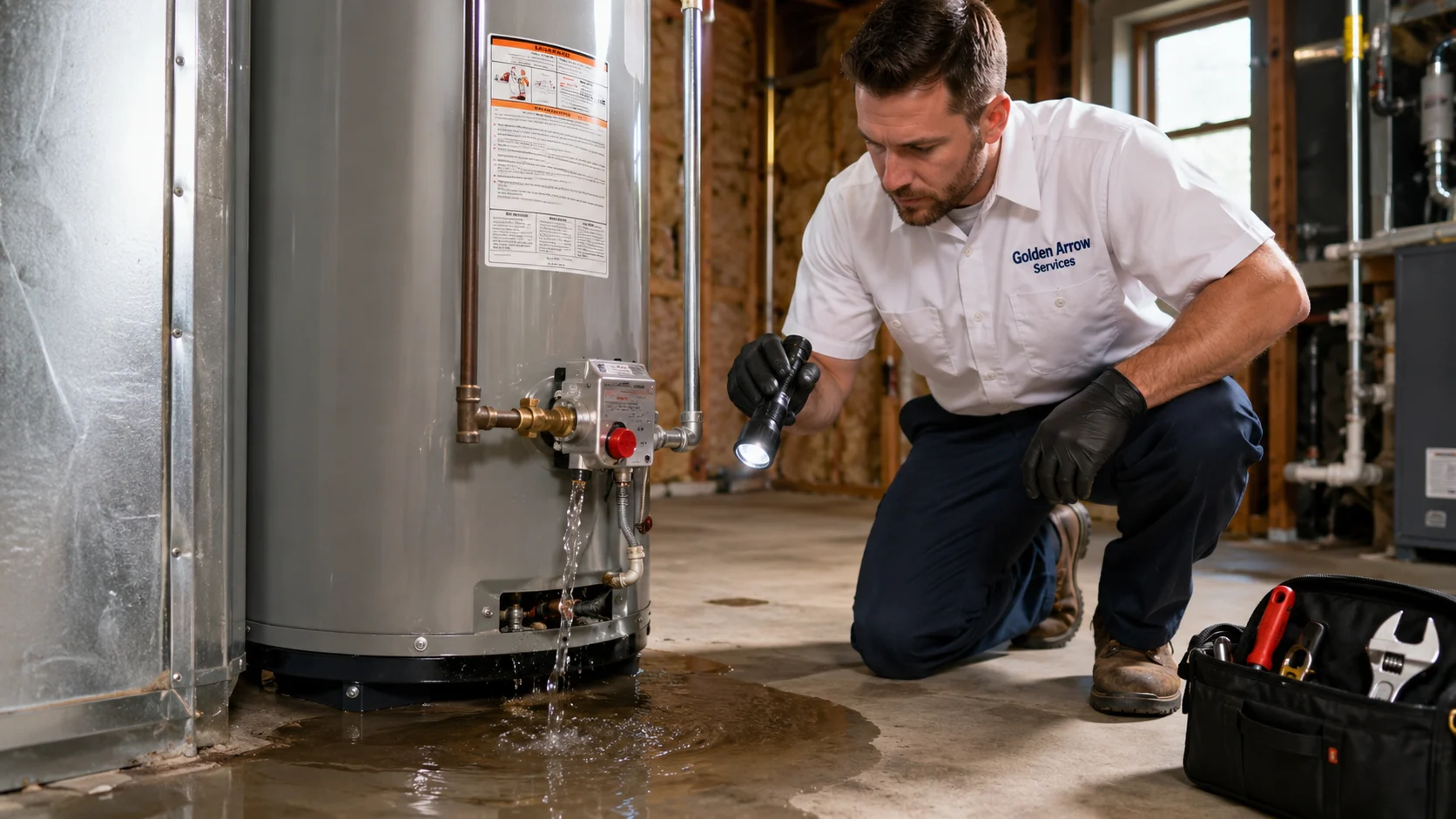

If your water heater is leaking in Northern Virginia, shut off the cold water supply, turn off electric or gas power if safe, stay away from standing water, and check where the leak starts. If water is spreading, spraying, or coming from the tank body, call a licensed technician quickly.
A leaking water heater can mean a loose pipe, bad valve, pressure issue, or failing tank. This guide explains what to do first, how to spot the source, and when repair or replacement makes more sense.
The First 5 Minutes: What to Do Before the Leak Spreads
When you search “what to do when your water heater is leaking,” the first step is damage control. Do not start by opening panels or testing parts. Start by stopping more water from entering the unit.
Shut Off the Cold Water Supply
Find the cold water shutoff valve above the water heater. It is usually on the pipe feeding water into the top of the tank.
Turn it clockwise until it stops. If the valve is stuck, do not force it hard enough to break the pipe.
If water keeps flowing, shut off the home’s main water valve. This is often near the water meter, basement wall, utility room, or where the main water line enters the house.
Turn Off Power or Gas Safely
For an electric water heater, turn off the breaker at the electrical panel. Do not touch the heater if water is near wires, panels, or outlets.
For a gas water heater, turn the gas control knob off if it is safe. If you smell gas, leave the home and call emergency help from outside.
The U.S. Department of Energy water heating guide notes that water heaters are a major home energy system, so leaks, overheating, and poor performance should not be ignored.
Protect the Area Around the Water Heater
Move boxes, rugs, tools, storage bins, and basement items away from the leak. Take photos of flooring, drywall, or stored items that are wet.
Use towels or a wet vacuum only if there is no electrical risk. Keep children and pets away until the area is safe.
Call a Professional If the Leak Is Active
Call for emergency water heater repair in Northern Virginia if the leak is heavy, near gas or electrical parts, or coming from the tank body.
Searches like “water heater leaking repair near me” and “same-day water heater repair” usually mean the problem needs fast inspection, not guesswork.
Find the Leak Source Without Taking the Unit Apart
You can often identify the general leak source without removing panels. Start at the top, then check the sides, valves, pipes, drain pan, and bottom seam.
|
Leak Location |
Most Likely Cause |
What It Usually Means |
| Top of tank |
Loose inlet/outlet connection, nipple leak, expansion tank issue |
Often repairable |
| Bottom of tank |
Drain valve leak, internal corrosion, tank failure |
Repair if valve; replacement if tank body |
| Side of tank |
T&P valve discharge, pressure issue |
Needs diagnosis |
| Drain valve |
Loose or faulty drain valve |
Often repairable |
| Pressure relief valve |
High pressure, bad valve, overheating |
Needs safety check |
| Pipe above heater |
Supply line, fitting, shutoff valve |
Usually plumbing repair |
| Tank body seam |
Internal corrosion |
Usually replacement |
| Water in pan only |
Slow drip, condensation, overflow, valve issue |
Needs inspection |
A water heater leaking from the top often points to a loose connection or expansion tank issue. A water heater leaking from the bottom can be simple if it is the drain valve, but serious if water comes from the tank body.
Is a Leaking Water Heater an Emergency or Can It Wait?
A leaking water heater may wait only when the leak is small, controlled, and away from gas or electrical parts. If water is spreading or the source is unclear, treat it as urgent.
It Is an Emergency If You See These Signs
Call quickly if water is spreading across the floor, leaking near wiring, spraying from a pipe, or coming from the tank body.
It is also urgent if you smell gas, see rusty water around the tank, cannot shut off the water, or have an old water heater leaking from the bottom.
It May Be Less Urgent, But Still Needs Service
A small drip from a fitting, a slow drain valve leak, or water only inside the drain pan may not mean immediate tank failure.
Still, it needs inspection. A small leak can become a bigger leak if pressure, corrosion, or a valve problem is behind it.
Why Waiting Can Make It Worse
Water damage can spread into flooring, drywall, trim, storage boxes, and basement finishes.
The EPA mold cleanup guidance recommends drying wet materials quickly because moisture can lead to mold growth. That is why even a small water heater leak should be handled early.
Why Your Water Heater May Be Leaking
If you are asking “why would a water heater leak” or “what causes a water heater to leak,” the answer depends on location, pressure, age, and tank condition.
Loose Water Connections
A water heater leaking from top areas often starts at the cold water inlet, hot water outlet, shutoff valve, or pipe fitting.
If water appears around the pipe above the heater, it may be a water heater supply line leaking, not the tank itself.
Faulty Drain Valve
A water heater leaking from the drain valve area usually shows water near the lower front of the tank.
The valve may be loose, cracked, worn, or not fully closed after flushing. This is often repairable.
Pressure Relief Valve or T&P Valve Problem
A water heater leaking pressure valve issue may come from high pressure, overheating, or a bad valve.
Do not cap or plug the relief valve. It is a safe part and needs proper diagnosis.
High Water Pressure
Too much pressure can push water out through valves and fittings.
A technician may need to check the pressure regulator, expansion tank, or T&P valve before replacing parts.
Sediment Buildup Inside the Tank
Sediment forms when minerals settle at the bottom of the tank. It can cause rumbling, popping, slow heating, and extra stress.
The ENERGY STAR water heater guidance explains that efficient water heating matters for energy use. A sediment-heavy tank often works harder and may wear out faster.
Internal Tank Corrosion
A water heater leaking from the bottom of the tank may mean internal corrosion. Rust weakens the tank until water escapes through the metal.
If the tank body is leaking, replacement is usually safer than repair.
Failed Anode Rod
The anode rod helps protect the tank from corrosion. When it fails, the inside of the tank becomes more vulnerable.
Rusty water, odor, and leaks can appear when corrosion has already advanced.
Old Age of the Water Heater
Many tank water heaters last around 8 to 12 years, depending on maintenance, water quality, and usage.
If an old water heater is leaking from the bottom, replacement often makes more sense than repeated repair.
Water Heater Leaking From the Bottom: What It Usually Means
A bottom leak can be minor or serious. The source matters.
Drain Valve Leak
The drain valve sits near the bottom of the tank. If water drips from the valve opening or threads, the valve may need tightening, resealing, or replacement.
This can happen after flushing or when the valve gets old.
Tank Corrosion Leak
If water comes from the base, seam, or tank body, the issue is more serious.
Internal corrosion is not a safe patch job. Replacement is usually the better long-term solution.
Pressure Relief Discharge Running Down the Tank
Sometimes water looks like it is leaking from the bottom, but the source is higher.
Water from the T&P valve can run down the side and collect near the base. Trace the wet path before assuming the tank bottom failed.
Condensation vs Real Leak
Condensation can mimic a leak, especially in humid areas or when cold water enters a warm tank.
But repeated puddles are not normal. Dry the area once. If water returns, schedule inspection.
When Bottom Leak Means Replacement
Replacement is more likely if the tank is old, rusty at the base, leaking from the seam, noisy, producing rusty water, or needing frequent repairs.
If repair cost reaches about 50% of new unit cost, replacement usually makes more sense.
Water Heater Leaking From the Top: What to Check First
A top leak is often more repairable than a tank body leak. Look at pipes, fittings, and nearby valves first.
Cold Water Inlet or Hot Water Outlet Leak
Check the two pipes entering and leaving the top of the heater.
Loose fittings, corrosion, or worn flexible connectors can cause a water heater leaking from the top issue.
Water Heater Nipple Leak
A nipple connects the tank to the water lines. If threads corrode or loosen, water may collect on the top.
This usually needs a plumber because forcing old fittings can damage the tank connection.
Expansion Tank or Shutoff Valve Leak
The water may come from the expansion tank, shutoff valve, or pipe above the heater.
That means the heater itself may not be leaking, but the system still needs repair.
T&P Valve Leak From Upper Side
A T&P valve leak can mean pressure, temperature, or valve failure.
If it keeps dripping, get a safety check before assuming it is harmless.
Can a Leaking Water Heater Be Repaired?
Many leaks can be repaired if the problem is a valve, pipe, gasket, fitting, or expansion tank. A leaking tank body usually cannot be repaired safely.
|
Problem |
Repair Possible? |
Best Action |
| Loose pipe fitting |
Yes |
Repair connection |
| Drain valve leak |
Yes |
Replace or reseal valve |
| T&P valve leak |
Usually |
Diagnose pressure/valve |
| Heating element gasket leak |
Sometimes |
Replace gasket/element |
| Expansion tank issue |
Yes |
Replace or repair expansion tank |
| Tank body corrosion |
Usually no |
Replace water heater |
| Bottom seam leak |
Usually no |
Replace water heater |
| 10–12+ year old leaking tank |
Often no |
Compare repair vs replacement |
| Frequent leaks/repairs |
Usually replacement better |
Full system evaluation |
If you are searching “how to repair a water heater leak,” first identify the source. Do not repair gas lines, electrical components, pressure valves, or tank corrosion yourself.
Why Northern Virginia Homes Should Act Fast
A water heater leaking Northern Virginia homeowners ignore can quickly affect more than the utility area.
Finished Basements Increase Water Damage Risk
Vienna, Fairfax, Arlington, and McLean homes often use basements for storage, laundry, living space, or HVAC equipment.
A leak can damage flooring, drywall, boxes, trim, and nearby mechanical systems.
Older Homes May Have Older Water Heater Setups
Older homes may have aging shutoff valves, old supply lines, tight utility spaces, or older tanks.
If replacement is needed, venting, gas connections, permits, and code requirements may also matter.
Hard Water and Sediment Can Shorten System Life
Northern Virginia homes can deal with mineral buildup inside tank water heaters.
That sediment can reduce efficiency, create noise, and increase stress near the bottom of the tank.
Winter Demand Can Make Problems Show Up Faster
Cold weather makes water heaters work harder because incoming water is colder.
A weak valve, old tank, pressure issue, or sediment-heavy heater may fail during higher winter demand.
What Not to Do When Your Water Heater Is Leaking
Do not ignore a small puddle. Do not keep using the heater if water reaches electrical parts.
Do not open the pressure relief valve without knowing the risk. Do not try to repair the gas yourself.
Do not patch a rusted tank body with sealant. Do not wait days if water is spreading.
Do not assume it is only condensation unless the area dries and stays dry.
When to Call Golden Arrow Service for Water Heater Leak Repair
Call Golden Arrow Service when the leak is active, the source is unclear, the tank is old, water is spreading, or you need emergency water heater repair in Northern Virginia.
Golden Arrow Service is based in Vienna and helps with gas, electric, tank, and tankless water heater repair, replacement, and installation. You can also visit the Golden Arrow Service website for local service information.
Golden Arrow Service
8740 Wolf Trap Road, Vienna, VA 22182
Phone: 703-782-5028
Find Us On Google Maps : https://maps.app.goo.gl/SGtsKxsABCr4U7nm8
Areas We Serve for Leaking Water Heaters
Golden Arrow Service helps with leaking water heaters in Vienna, Fairfax, Arlington, McLean, Tysons, Oakton, Falls Church, Centreville, Alexandria, Reston, Herndon, Dunn Loring, Merrifield, Great Falls, Manassas, Sterling, and nearby Northern Virginia communities.
How to Prevent Another Water Heater Leak
Prevention is easier than cleaning up water damage.
Schedule Annual Water Heater Maintenance
Annual service should include checking valves, inspecting connections, looking for corrosion, testing the T&P valve, checking the expansion tank, and inspecting the drain pan.
These checks can catch small issues before they become leaks.
Flush Sediment When Needed
Flushing can help remove sediment from the bottom of the tank.
Homes with harder water may need closer monitoring. Older heaters should be inspected before flushing because heavy sediment can clog valves.
Watch for Early Warning Signs
Watch for rumbling, rusty water, slow hot water recovery, pressure changes, small drips, higher energy bills, or water in the pan.
These signs do not always mean failure, but they do mean the heater needs attention.
Replace Before the Tank Fails
Replacement may be safer when the tank is old, rusty, leaking from the body, or needing frequent repairs.
Replacing before full failure can prevent basement damage and emergency disruption.
FAQ About Leaking Water Heaters
Q1: Should I turn off my water heater if it is leaking?
Yes. Turn off the cold water supply first. Then turn off electric power at the breaker or gas power at the control valve if safe. If water is near electrical parts, stay away and call a professional.
Q2: Is a leaking water heater dangerous?
It can be dangerous when water is near electricity, gas components, hot water discharge, or active flooding. A small drip from a fitting may be less urgent, but it still needs inspection.
Q3: Why is my water heater leaking from the bottom?
A water heater leaking from the bottom may have a drain valve leak, pressure relief discharge, condensation, or internal tank corrosion. If water comes from the tank body or seam, replacement is usually likely.
Q4: Why is my water heater leaking from the top?
A top leak usually comes from a loose cold water inlet, hot water outlet, nipple connection, expansion tank, shutoff valve, or T&P valve. These are often repairable.
Q5: Can a leaking water heater be repaired?
Yes, if the leak comes from a valve, pipe fitting, gasket, or expansion tank. Usually no if the tank body is corroded or leaking from the seam.
Q6: How much does water heater leak repair cost in Northern Virginia?
Minor repairs may start around a few hundred dollars. Replacement or tankless conversion costs more. Final cost depends on leak source, heater type, access, parts, permits, and whether repair or replacement is safer.
Q7: Who should I call for a leaking water heater near me?
Call a licensed plumber or HVAC water heater technician serving your area. In Vienna, Fairfax, Arlington, McLean, and nearby Northern Virginia, choose a local team that can explain repair versus replacement clearly.
Q8: Can I still shower if my water heater is leaking?
Avoid using it if the leak is active, near electrical or gas parts, or coming from the tank body. If it is a small controlled drip away from safety hazards, get it inspected before normal use continues.