
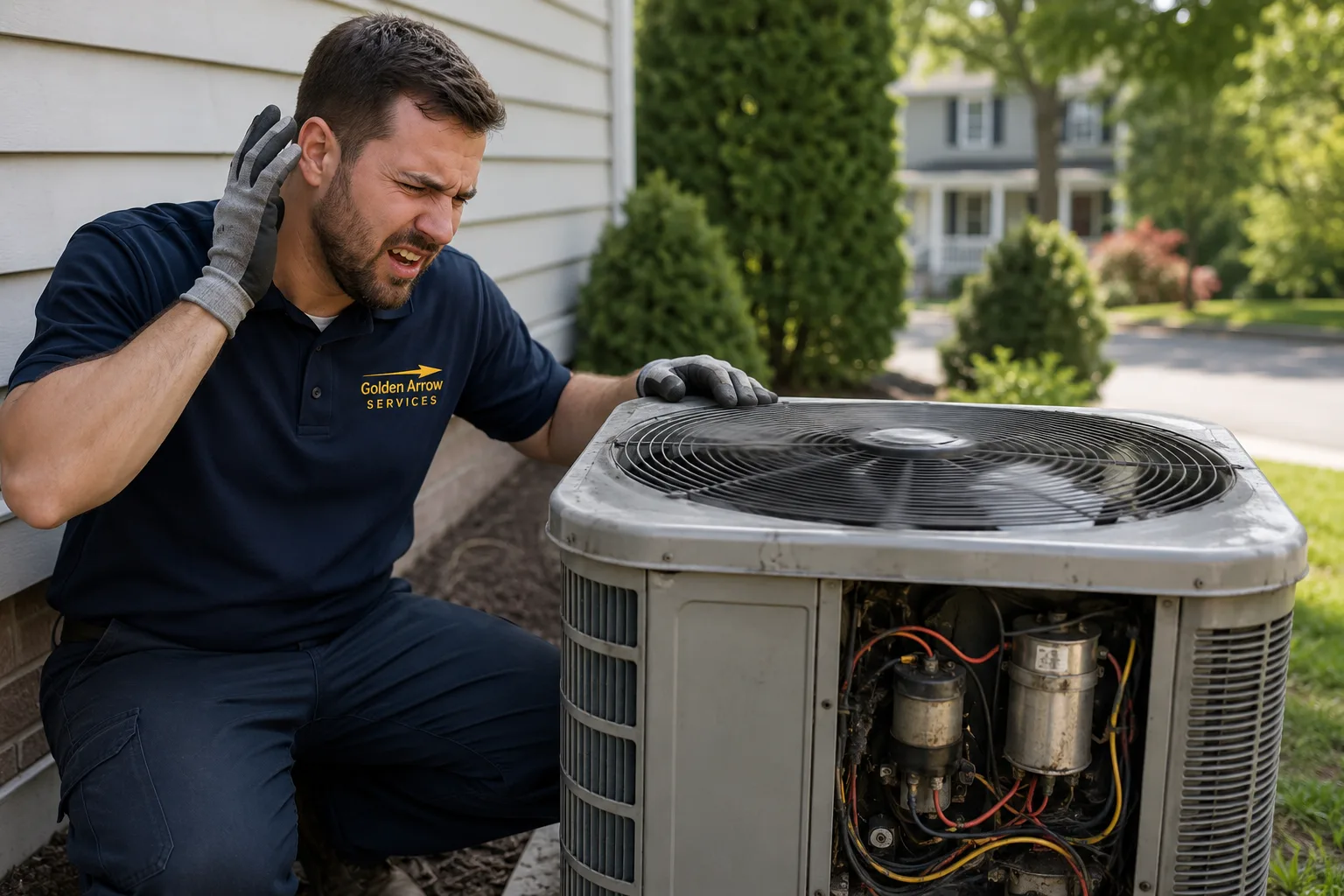

Written by the Golden Arrow Service team, licensed and insured HVAC contractors serving Vienna, VA and Fairfax County for over 25 years. A loud banging usually means a loose or failing compressor part. A rattling noise usually means loose hardware, a failing fan, or debris in the outdoor unit. Banging is urgent: shut the system off and call a technician. Rattling is sometimes a simple fix. Here is how to tell them apart. TL;DR
- Banging = compressor or loose internal part. Turn the AC off.
- Rattling = loose screws or debris. Often minor, but check it.
- Need help fast? Call Golden Arrow Service in Vienna, VA at (703) 782-5028.
Where is the sound coming from?
Find two things first: where the noise is, and when it happens.
- Outdoor unit = debris, fan, or compressor.
- Indoor air handler or vents = blower or ductwork.
- At startup = a loose part shifting.
- When the AC is off = an electrical part like a contactor still getting power.
These clues tell your technician where to look.
AC noise quick reference: cause and urgency
Match your sound to its likely cause and how fast you need to act.
|
Sound |
Most likely cause |
DIY or pro? |
Urgency |
| Banging | Loose or failing compressor part |
Pro |
High, shut it off |
| Rattling | Debris or loose panel/fan blade |
DIY check, then pro |
Low to medium |
| Clanking | Unbalanced fan blade or loose part |
Pro |
Medium to high |
| Buzzing | Failing capacitor, contactor, or wiring |
Pro |
Medium |
| Humming | Normal, or a part under strain |
Pro if loud |
Low to medium |
| Clicking | Normal once, bad if constant |
Pro if repeated |
Low to medium |
| Hissing / whistling | Refrigerant leak |
Pro |
High |
| Squealing / screeching | Worn belt, dry bearings, compressor pressure |
Pro |
High |
| Whirring | Fan motor problem |
Pro |
Medium |
| Pulsating | Failing capacitor |
Pro |
Medium |
| Bubbling | Refrigerant or drain issue |
Pro |
Medium |
| Popping / cracking | Duct expansion (normal) or frozen coil |
DIY check |
Low |
Why is my AC making a banging noise?
A banging AC usually means a loose or broken part inside the compressor, like a connecting rod or piston pin. The compressor is the heart of your system, so this is the most serious noise. A single clunk at startup can be a part of settling. A repeated bang means metal is hitting metal. What to do: turn the system off and leave it off. Running it can turn a repair into a full compressor replacement. Call a licensed technician.
Why is my AC rattling?
A rattling AC usually means loose hardware or debris, not a dying compressor. Common causes are loose panel screws, a loose fan blade, or sticks and leaves in the outdoor condenser. This is the one noise you can safely check yourself:
- Turn off power at the disconnect or breaker.
- Clear leaves, twigs, and gravel from the outdoor unit.
- Tighten any loose panel screws.
The U.S. Department of Energy recommends at least two feet of clearance around the outdoor unit. If the rattle continues after you clean it, the cause is likely internal. Call a pro.
Banging vs. rattling vs. clanking: how to tell them apart
Rattling is mildest, clanking is worse, banging is most serious.
- Rattling = debris or a loose panel. Often I can wait a day.
- Clanking = a loose or unbalanced part. Needs prompt attention.
- Banging = a compressor problem. Shut it off now.
What other AC noises mean
Quick answers for every other sound:
- Buzzing = electrical: failing capacitor, contactor, or loose wiring.
- Humming = often normal; a loud hum means a part is straining.
- Clicking = normal once at startup; constant clicking means a failing relay or capacitor.
- Hissing or whistling = a refrigerant leak. Under EPA Section 608, only a certified technician can handle refrigerant, so never DIY this.
- Squealing or screeching = worn belt, dry bearings, or high compressor pressure.
- Whirring = fan motor problem.
- Pulsating = weak capacitor.
- Bubbling = refrigerant or condensate drain issue.
- Popping or cracking = usually ducts expanding (normal), unless a coil is frozen.
Is it safe to keep running my AC with a noise?
No, not for every sound. Shut the AC off for banging, squealing, hissing, or electrical buzzing. These point to compressor, refrigerant, or electrical faults that get worse fast.
- Turn it off: banging, squealing, hissing, burning or buzzing smell.
- OK to run briefly: light hum, single click, popping from ducts.
- Check then decide: a persistent rattle.
When in doubt, turn it off and call a technician. It is always the cheaper choice.
What AC noise repairs cost in Vienna, VA
Cost depends on the part. Golden Arrow Service quotes every job in writing first.
|
Repair |
Typical cost range |
| Tighten panels / clear debris |
Often part of a service call |
| Capacitor replacement |
$100 to $350 |
| Contactor replacement |
$150 to $350 |
| Refrigerant leak repair and recharge |
$200 to $600 |
| Fan motor replacement |
$300 to $700 |
| Compressor replacement |
$800 to $2,500 |
| Service call and diagnostic |
$89 to $125 |
Repair or replace? If a repair costs more than 50% of a new system and your unit is over 10 to 15 years old, replacement usually makes better sense.
Why AC noises are common in Northern Virginia homes
Northern Virginia weather is hard on air conditioners, and that shows up as noise.
- Spring: oak pollen and storm debris clog outdoor condensers across Fairfax County, a top cause of rattling in Vienna.
- Summer: long humid run-times loosen hardware and wear out capacitors and compressor mounts.
- Older homes: aging ductwork in neighborhoods like Wolf Trap and Windover Heights rattles and pops.
Think the noise is in your ducts? See our guide on signs your home needs new ductwork. Most noises are preventable. The Department of Energy advises changing filters every month or two, and a yearly tune-up catches loose parts early. Book annual AC maintenance to keep your Vienna system quiet.
What the Noise Timing Can Tell You
If your AC makes a loud noise when starting, pay attention — startup banging can point to compressor stress, loose mounting parts, or fan trouble. If your AC makes noise when shutting off, the cause may be duct movement, pressure changes, or loose components.
Safe Checks You Can Do Before Calling an HVAC Technician
Before calling for AC repair, there are a few safe checks you can do:
- Turn the AC off at the thermostat
- Check the air filter
- Make sure supply and return vents are open
- Look around the outdoor unit for leaves or debris
- Check visible exterior panels
- Listen for where the sound is coming from
- Note whether the AC is still cooling
Do not open the compressor, capacitor, refrigerant lines, electrical compartment, motor housing, or sealed panels — these parts can be dangerous and should be handled by a licensed HVAC technician.
How to Prevent AC Noise Problems in Northern Virginia Homes
Northern Virginia summers are hot and humid, and during long cooling cycles small AC problems can become more noticeable. To help prevent noisy AC issues:
- Replace filters on time
- Keep the outdoor condenser clear
- Trim plants around the unit
- Keep vents open
- Schedule seasonal AC maintenance
- Fix small rattles early
- Do not ignore new startup noises
- Have older ductwork checked if vents rattle
Regular maintenance helps reduce vibration, airflow problems, dirty condenser issues, worn parts, and unexpected breakdowns.
How Golden Arrow Service fixes noisy AC units in Vienna
Golden Arrow Service has repaired noisy air conditioners in Vienna and Fairfax County for over 25 years.
- Licensed technicians who find the root cause.
- Written upfront quote before any work.
- Most repairs done on the first visit.
- All major brands: Carrier, Trane, Lennox, Rheem, plus heat pumps and ductless mini splits.
Book same-day AC repair in Vienna, VA or call now. Golden Arrow Service 8740 Wolf Trap Road, Vienna, VA 22182 call or text: (703) 782-5028 Find us on Google Maps : https://maps.app.goo.gl/SGtsKxsABCr4U7nm8
Frequently asked questions
Q1: Why is my AC making a loud banging noise when it starts?
A banging noise at startup usually means a loose or failing part inside the compressor, such as a connecting rod or piston pin. Turn the system off and have a licensed technician inspect it before the part causes more damage.
Q2: Is a rattling AC dangerous?
Usually not right away. Rattling is often just debris or loose screws. But if it continues after you clear debris and tighten panels, it can mean a failing fan motor or capacitor and should be inspected.
Q3: Should I turn off my AC if it is making a loud noise?
Yes, for banging, squealing, hissing, or electrical buzzing. These point to faults that worsen the longer the unit runs. A light hum or single click is generally safe while you book service.
Q4: Can a loose or broken fan blade cause the noise?
Yes. A loose or bent fan blade is a common cause of rattling, clanking, or banging, especially at startup. It can strike the housing and damage the motor. Tightening or replacing it is usually a quick repair.
Q5: Why does my AC make noise even when it is turned off?
Electricity still flows to the outdoor unit when the system is off, so buzzing or humming while idle usually means a faulty contactor or relay. Have it checked promptly to avoid further damage.
Q6: How much does it cost to fix a noisy AC in Vienna, VA?
A capacitor or contactor runs about $100 to $350, a refrigerant leak repair $200 to $600, and a compressor replacement $800 to $2,500. Golden Arrow Service charges an $89 to $125 diagnostic fee, applied to the repair. Call (703) 782-5028.