
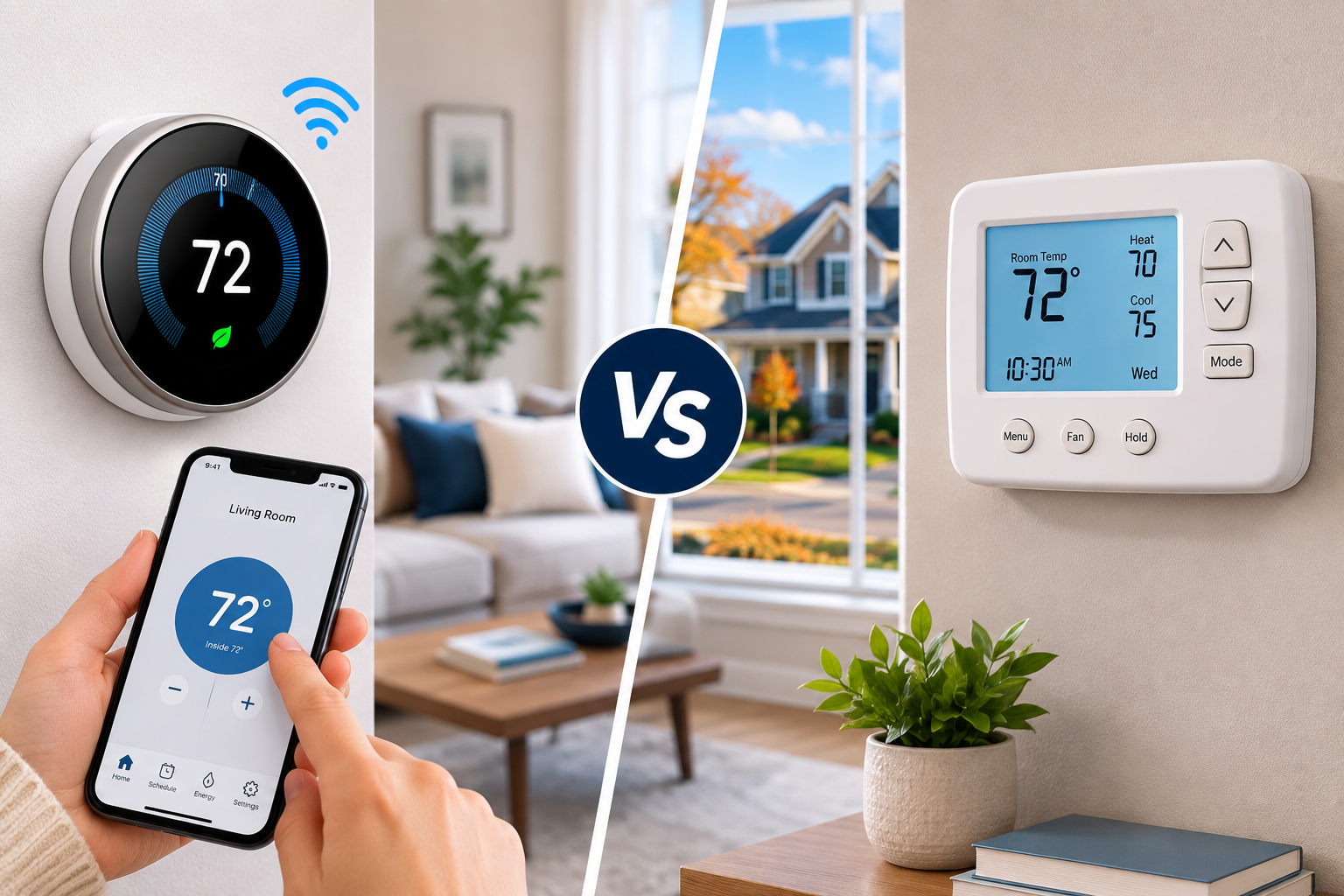

Smart vs. Programmable Thermostat:A programmable thermostat costs less upfront, around $150-$300 installed, and saves roughly 10% a year on heating and cooling if you stick to a fixed schedule. A smart thermostat costs more upfront, typically $200-$500 installed, but adjusts automatically to Northern Virginia’s variable commute and hybrid-work schedules, and it manages heat pump auxiliary heat more efficiently than a basic programmable model. If your home has a heat pump or was built before 1990, that changes which one actually makes sense for you.
Key Takeaways
- A programmable thermostat is cheaper and works well only if your household follows a truly consistent daily schedule.
- A smart thermostat costs more but adapts on its own, which matters in Northern Virginia given how often DC-area work schedules shift week to week.
- If you have a heat pump, thermostat choice directly affects how often the system falls back to expensive auxiliary or emergency heat.
- Homes built before 1990 in Vienna, Fairfax, and the wider Northern Virginia area sometimes lack the C-wire a smart thermostat needs, which changes installation cost and scope.
- ENERGY STAR certified smart thermostats are independently field-tested to deliver real energy savings, not just claimed savings.
Table of Contents
- What’s the Actual Difference?
- Why This Question Matters More in Northern Virginia
- If You Have a Heat Pump, This Changes the Math
- The Older-Home Factor: Do You Even Have a C-Wire?
- Real Savings, Real Sources
- Which One Should You Actually Buy?
- What Golden Arrow Recommends and Installs
- Frequently Asked Questions
Quick Answer Table
| Factor | Programmable Thermostat | Smart Thermostat |
| Typical installed cost (Northern Virginia) | $150-$300 | $200-$500 |
| Requires Wi-Fi/app | No | Yes |
| Adjusts to schedule changes automatically | No, fixed schedule only | Yes, learns and adapts |
| Typical savings vs. no schedule at all | Around 10%/year with consistent use | Often 8-15%, more in multi-story or irregular-schedule homes |
| Works well with a heat pump’s auxiliary heat | Basic, no smart lockout logic | Better, many models manage aux/emergency heat more efficiently |
| Needs a C-wire | Usually no | Often yes, or a power-stealing/adapter workaround |
| Remote/phone control | No | Yes |
What’s the Actual Difference?
A programmable thermostat runs on a fixed internal clock. You set a schedule, weekday and weekend temperatures at set times, and it repeats that same schedule every day whether or not it actually matches what’s happening in your house that day. It doesn’t need Wi-Fi, a smartphone, or an app to work.
A smart thermostat is Wi-Fi-connected and does something fundamentally different: it learns your actual patterns, adjusts to weather changes ahead of time, and can be controlled remotely from your phone. Many models use geofencing, meaning the thermostat knows when your phone (and you) are approaching home and starts adjusting the temperature before you walk in, something a programmable thermostat simply cannot do because it has no way to sense where you actually are.
The mechanism difference matters more than the feature-list difference: a programmable thermostat assumes your life is the same every day. A smart thermostat assumes it isn’t, and adjusts.
Why This Question Matters More in Northern Virginia
This decision isn’t the same everywhere, and Northern Virginia is a specific case. DC-area commuting and hybrid-work patterns mean a lot of households here don’t actually have one fixed daily schedule. Someone in your home might be in the office Tuesday and Thursday, remote the rest of the week, with meetings that run long or start early depending on the day. A programmable thermostat built around a single repeating schedule fights against that reality, either running the house at “away” temperature while someone’s actually home working, or at “home” temperature while the house sits empty.
Northern Virginia’s humid, four-season climate adds a second layer: swings between muggy summer afternoons and cold snaps in winter mean a thermostat that reacts to actual weather, not just a clock, has more to work with here than in a milder, more predictable climate.
If You Have a Heat Pump, This Changes the Math
If your Northern Virginia home runs on a heat pump rather than a furnace, thermostat choice stops being just about comfort and starts affecting your bill directly. Heat pumps have a secondary heat source, auxiliary heat (electric resistance backup that kicks in automatically when the heat pump alone can’t keep up) and a separate emergency heat mode that runs on backup heat only. Both are far more expensive to run than the heat pump’s normal compressor-driven heating.
A basic programmable thermostat has no logic for managing this distinction; it just calls for heat when the temperature drops below the setpoint, and the system decides how to deliver it. Many smart thermostats are built with heat-pump-aware logic that avoids triggering aux heat unnecessarily, for example by making smaller, more gradual setback adjustments instead of large temperature swings that force the system into backup mode to catch up quickly. If your heat pump has ever kicked into emergency heat unexpectedly, that’s worth understanding before you decide, see our guide on why your heat pump might run in emergency heat mode for the full breakdown of triggers and fixes.
If you’re still deciding whether a heat pump itself is the right fit for your home in the first place, our Northern Virginia heat pump guide covers that decision separately.
The Older-Home Factor: Do You Even Have a C-Wire?
Most smart thermostats need a C-wire (common wire) to stay continuously powered. Many homes built before 1990, common throughout Vienna, Fairfax, and the rest of Northern Virginia, were wired for simple mechanical or basic digital thermostats and never had a C-wire run to the thermostat location at all.
This isn’t a dealbreaker, but it does change the installation. Some smart thermostats work around a missing C-wire using power-stealing technology or an included adapter kit; others need an actual C-wire added, which is minor electrical work best done by a licensed technician rather than attempted as a DIY swap. If your home has other signs of older, non-standard wiring or ductwork, this is frequently connected: we cover the broader pattern in why older Northern Virginia homes built before 1990 often have duct problems, which is worth a read if your home falls into that build era.
Before buying a smart thermostat for an older home, check behind your current thermostat for a wire labeled “C.” If it’s not there, plan for either a compatible power-stealing model or a short electrical add-on as part of installation, not a separate, unplanned trip.
Real Savings, Real Sources
The often-repeated “8-10 degree setback saves 10%” figure is real, but it’s worth citing properly instead of just repeating it. According to ENERGY STAR, heating and cooling account for almost half of the average American household’s annual energy bill, more than $900 a year, which is exactly why thermostat behavior has an outsized effect on your total bill. ENERGY STAR certified smart thermostats are independently certified based on actual field data to deliver real energy savings, not just modeled or claimed savings, which is a meaningful distinction when you’re comparing models.
The practical takeaway: whichever thermostat you choose, the savings only materialize if the setback schedule is actually followed consistently, either by you (programmable) or by the thermostat’s own learning algorithm (smart).
Which One Should You Actually Buy?
Neither option is universally “better,” it depends on your household:
A programmable thermostat is the right call if your schedule is genuinely consistent week to week, you don’t want to deal with an app or Wi-Fi setup, and you want the lower upfront cost.
A smart thermostat is the right call if your schedule varies (hybrid work, irregular commutes, kids’ activities), you have a heat pump and want smarter aux-heat management, you want remote control and usage insight from your phone, or you want ENERGY STAR-certified, field-verified savings performance.
If your home was built before 1990, factor in the C-wire check above regardless of which type you’re leaning toward, it affects installation cost and timeline either way.
What Golden Arrow Recommends and Installs
We install and service both programmable and smart thermostats across Vienna, Fairfax, McLean, Centreville, and the rest of Northern Virginia. Before recommending either type, our technicians check your existing wiring (including C-wire availability), confirm compatibility with your specific system (standard furnace, heat pump, or dual-fuel setup), and walk through your household’s actual schedule with you rather than defaulting to whichever unit is easiest to sell. If you have a heat pump, we’ll specifically account for auxiliary/emergency heat behavior in the recommendation, not just upfront price.
Golden Arrow Service
8740 Wolf Trap Road, Vienna, VA 22182 Call or text: (703) 782-5028 Find us on Google Maps: https://maps.app.goo.gl/SGtsKxsABCr4U7nm8
Family-owned and serving Northern Virginia since 1999, licensed, bonded, and insured, with NATE-certified technicians, same-day service (2-4 hour arrival windows), a free second opinion, no hidden fees, and a 100% satisfaction guarantee. Explore our full heat pump services if a heat pump is part of your decision.
Frequently Asked Questions About Smart vs. Programmable Thermostat
Do I need Wi-Fi for a smart thermostat to work at all?
Most core scheduling functions still work without Wi-Fi, but you lose remote control, geofencing, and weather-responsive adjustments, the features that separate a smart thermostat from a programmable one, if the connection drops.
Can a smart thermostat work without a C-wire?
Often yes, through power-stealing technology or an included adapter kit, but not universally. It depends on the specific model and your existing HVAC system, which is why a wiring check before purchase matters, especially in older Northern Virginia homes.
Will a smart thermostat actually lower my bill, or is that marketing?
For ENERGY STAR certified models, savings are independently verified using real field data, not just manufacturer claims. Actual savings still depend on how consistently the setback schedule runs, whether set manually or learned automatically.
Does thermostat type matter if I don’t have a heat pump?
Less so. The auxiliary/emergency heat management advantage is specific to heat pump systems. With a standard gas furnace, the difference between smart and programmable comes down mainly to schedule flexibility and remote control, not backup-heat cost avoidance.
How much does professional thermostat installation cost in Northern Virginia?
Typical installed pricing runs $150-$300 for a programmable thermostat and $200-$500 for a smart thermostat, depending on your existing wiring and whether any electrical work (like adding a C-wire) is needed.
What’s the difference between auxiliary heat and emergency heat on a heat pump?
Auxiliary heat kicks in automatically alongside the heat pump when it needs extra help. Emergency heat runs on backup heat only, with the heat pump’s compressor off entirely, usually because of a manual switch or a system fault. See our full breakdown for the complete list of triggers.