
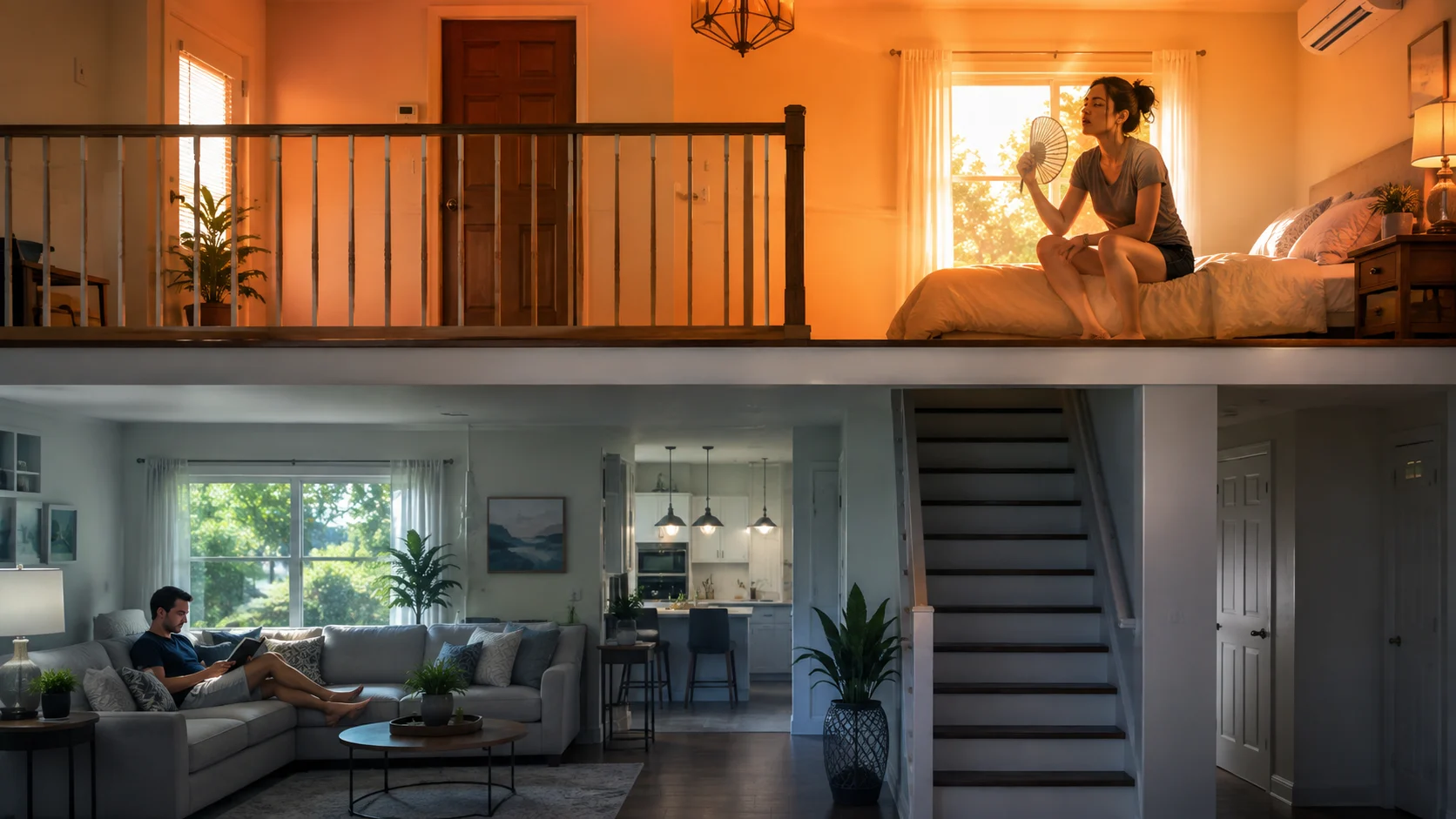

Your upstairs is hotter than downstairs because heat naturally rises, your roof and attic add extra heat load onto the second floor, and — especially in Northern Virginia’s older housing stock — undersized or leaky ductwork can’t deliver enough cooled air upstairs. A 2–3°F gap between floors is normal. A 5°F or larger gap points to a real duct, insulation, or equipment problem, not just physics.
TL;DR
● Heat rising (the “stack effect”) explains part of the gap, but it does not explain 8–10°F differences — that’s usually ductwork, insulation, or an undersized system.
● A single central return and a downstairs-only thermostat, common in Vienna and Fairfax homes built before 1990, are the single biggest reason two-story NoVA homes run hot upstairs.
● Start with free adjustments (fan setting, vents, blinds), then duct balancing, then zoning or a second system — in that order.
● Golden Arrow Service diagnoses upstairs cooling problems throughout Vienna, Fairfax, and Northern Virginia with same-day service. Call or text (703) 782-5028.
Quick Answer: How Big a Gap Is Normal?
|
Gap between floors |
What it means |
| 2–3°F |
Normal. This is the baseline effect of heat rising in any two-story home. |
| 4–5°F |
Borderline. Worth a look, especially during Northern Virginia’s humid July–August stretch. |
| 5°F or more |
A real problem — almost always ductwork, insulation, or equipment sizing, not just physics. |
| 8–10°F |
Commonly reported in older two-story Vienna and Fairfax homes with original, pre-1990 ductwork and a single central return. |
Why Upstairs Gets Hotter First
Warm air is less dense than cool air, so it rises and collects on the upper floor while cooler air settles downstairs — this is the same “stack effect” that makes a stairwell feel like a chimney in summer. On its own, this physics accounts for a modest, 2–3°F difference between floors.
Northern Virginia adds two regional factors that push that gap higher. Summers here are long, hot, and humid, with attic temperatures regularly climbing past 120°F, and that heat radiates down through the ceiling into upstairs bedrooms. And in this area specifically, roughly two out of three homes in Fairfax County were built before 1990, with Vienna’s average home dating to 1977 — meaning most local two-story houses are running on ductwork that was sized by a square-footage rule of thumb rather than a real room-by-room load calculation, with a single central return that can’t keep up once you add a second floor.
Signs It’s a Duct Problem
● Weak or barely-there airflow at upstairs vents compared to downstairs.
● The system short cycles — it shuts off once the downstairs thermostat is satisfied, even though upstairs is still warm.
● One or two specific rooms run noticeably hotter than the rest of the floor.
● Whistling, rattling, or booming sounds from the ductwork when the system cycles on.
● Your home was built before 1990 and the ductwork has never been inspected.
Signs It’s an Insulation or Attic Problem
● The gap between floors gets worse specifically in the afternoon and evening, when the attic has had all day to absorb heat.
● Upstairs stays hot well after sunset, even once outdoor temperatures drop.
● You can feel heat radiating from the ceiling in upstairs rooms.
● The attic has little or no visible insulation, or insulation that’s compressed, wet, or missing in patches.
● Attic soffit vents are blocked or covered, restricting the natural airflow that’s supposed to carry heat back outside.
Signs It’s an Equipment or Sizing Problem
● The system runs almost constantly during peak summer afternoons but still can’t close the gap.
● Your AC or heat pump is original to the home and approaching or past 12–15 years old.
● The home has a single-zone system with one thermostat, typically located downstairs, controlling both floors.
● A previous room addition, finished basement, or converted attic space was added without resizing the original system.
Northern Virginia Factors That Make This Worse
This isn’t just a general HVAC issue — it’s a specific, well-documented pattern in this region’s housing stock. As Golden Arrow Service covers in detail in why older Northern Virginia homes built before 1990 often have duct problems, ductwork installed before the early 1990s was typically sized using a simple square-footage estimate rather than a proper Manual J load calculation, and it usually shipped with a single central return instead of a return in every room. That combination is, in that article’s own words, “a big reason upstairs bedrooms in older two-story Vienna and Fairfax homes run several degrees warmer than the main floor, even with the air conditioner working hard.” Golden Arrow’s own duct installation page makes the same point: uneven temperatures between rooms are “especially common in two-story homes in this area, where the second floor overheats in summer.”
Three to five decades of sagging flex duct, dried-out tape at the joints, and uninsulated attic runs only widens the gap further. If your home falls into that pre-1990 category, that article’s repair-or-replace decision table is worth reading before you assume you need a whole new HVAC system.
What Golden Arrow Actually Checks
Rather than guessing, a proper diagnosis starts with measurement. On a service call for an upstairs-hotter-than-downstairs complaint, our technicians check supply and return airflow at the upstairs registers, inspect accessible ductwork for sagging, disconnected, or crushed sections, verify attic insulation depth and soffit vent clearance, and confirm the system is correctly sized for the home’s actual square footage rather than assuming the original installation got it right. That assessment tells us — and you — whether the fix is a $0 vent adjustment or a full duct rebalance, instead of defaulting to the most expensive option first.
Fix It in 3 Tiers
● Free or DIY first steps. Switch the thermostat fan from “auto” to “on” so air keeps circulating between cooling cycles. Close blinds on upstairs windows during peak sun hours. Run ceiling fans counterclockwise in summer. As a temporary measure only, you can partially — never fully — close a few downstairs vents to nudge more air upstairs; closing vents completely can freeze the evaporator coil or strain the system.
● Moderate: duct balancing and sealing. If the free adjustments don’t close the gap, the next step is professional duct balancing — measuring airflow at each register and adjusting dampers so the upstairs gets a fairer share of total capacity — combined with sealing any leaky joints found in an inspection. This is typically the highest-value fix for pre-1990 Vienna and Fairfax homes, since it directly addresses the undersized-duct-and-single-return pattern described above.
● Premium: zoning or a second system. If duct balancing alone doesn’t solve it, or if the home’s cooling load genuinely exceeds what one system can handle, a zoning system (motorized dampers controlled by a separate upstairs thermostat) or a dedicated ductless mini-split for the second floor gives you independent control instead of forcing one thermostat to serve two very different loads.
Cross-System Considerations
An “upstairs hotter than downstairs” complaint sometimes turns out to be a different problem wearing a duct-problem costume. If your system runs constantly and still can’t keep the house cool regardless of floor, work through Golden Arrow’s heat pump not heating or cooling diagnostic guide to rule out a refrigerant, reversing valve, or airflow fault in the equipment itself before assuming it’s purely a ductwork issue. And if you’re weighing a full system replacement rather than a repair, Golden Arrow’s heat pump vs. gas or electric furnace guide for Northern Virginia covers how equipment choice interacts with two-story cooling performance. If a technician recommends a smart thermostat as part of the fix, Golden Arrow’s smart vs. programmable thermostat guide explains what it can and can’t do for uneven temperatures, particularly on a heat pump system.
Red Flags When Getting a Second Opinion
A technician who glances at your thermostat and immediately quotes a full system replacement, without measuring airflow at the upstairs registers or inspecting accessible ductwork, is skipping the diagnostic step that actually identifies the cause. The same caution applies to duct work specifically: cheap, no-inspection “whole-house” offers are a known pattern in this region. Golden Arrow’s guide on how to spot a duct cleaning scam in Northern Virginia covers the red flags to watch for before anyone touches your ductwork. A legitimate technician inspects first, explains what they found in plain terms, and gives you a written price before starting any work.
How to Confirm the Fix Actually Worked
After any repair — vent adjustment, duct balancing, or a zoning install — check the gap between floors with a simple thermometer at the same time of day, ideally mid-to-late afternoon, over 48 hours. You’re looking for the gap to fall back into the 2–3°F normal range from the Quick Answer table above. If it’s still running 5°F or higher after the fix, that’s a sign the original diagnosis missed something, and it’s worth going back to whoever did the work rather than assuming this is just how your house is.
Get Your Upstairs Cooling Checked in Vienna, Fairfax, or Northern Virginia
If your upstairs runs hotter than downstairs no matter what you try, Golden Arrow Service will measure the actual airflow and ductwork condition before recommending anything — no default upsell to a full system replacement.
Golden Arrow Service
8740 Wolf Trap Road, Vienna, VA 22182
Call or text: (703) 782-5028
Find us on Google Maps: https://maps.app.goo.gl/SGtsKxsABCr4U7nm8
Frequently Asked Questions
Q1: How many degrees hotter is normal for an upstairs compared to downstairs?
A 2–3°F difference is normal in any two-story home because warm air naturally rises. A 5°F gap or more usually points to a duct, insulation, or equipment problem. Some older two-story Vienna and Fairfax homes with original pre-1990 ductwork report gaps of 8–10°F.
Q2: Should I close my downstairs vents to cool the upstairs?
Partially closing a few downstairs vents can nudge more airflow upstairs as a temporary measure, but never close vents completely. Doing so restricts airflow back to the system and can freeze the evaporator coil, which makes cooling worse, not better, and can strain the equipment.
Q3: Does running the AC fan constantly help even out the temperature?
Yes, switching the thermostat fan setting from “auto” to “on” keeps air circulating between cooling cycles, which helps mix the air between floors. It’s a free adjustment worth trying before anything else, though it uses a bit more electricity and increases blower wear over time.
Q4: Is it worth installing a second AC unit just for the upstairs?
It can be, but it’s usually the last step, not the first. Duct balancing and sealing solve the problem for most older Northern Virginia homes at a fraction of the cost. A second system or zoning makes more sense when the home’s cooling load genuinely exceeds one system’s capacity, or when duct balancing alone hasn’t closed the gap.
Q5: Why does the upstairs feel even hotter at night?
Heat absorbed by the roof and attic all day continues radiating into upstairs rooms well after sunset, so the gap can feel worse at night even as outdoor temperatures drop. Poor attic insulation and limited attic ventilation make this lag worse.
Q6: Will a smart thermostat fix an upstairs that’s always hot?
Not by itself. A smart thermostat can improve scheduling and, on a heat pump, manage auxiliary heat more efficiently, but it can’t compensate for undersized ductwork, a single central return, or missing attic insulation. If those are the actual cause, a smart thermostat won’t close the gap.